


Before the pioneers. Before the territory. Before the state had a name.
The Ute were here.
They call themselves Núuchi-u. The People. Their homeland stretched across most of present-day Utah, western Colorado, and into parts of New Mexico and Wyoming. The Spanish called them Yutas. The forever ago people. Utah bears their name.
This is their story.
In the Beginning
The Ute do not have a migration story. The Southern Ute elder Alden Naranjo said it plainly in the Ute Creation Story as recorded by the Southern Ute Indian Tribe: the Utes have always lived here in the mountains.
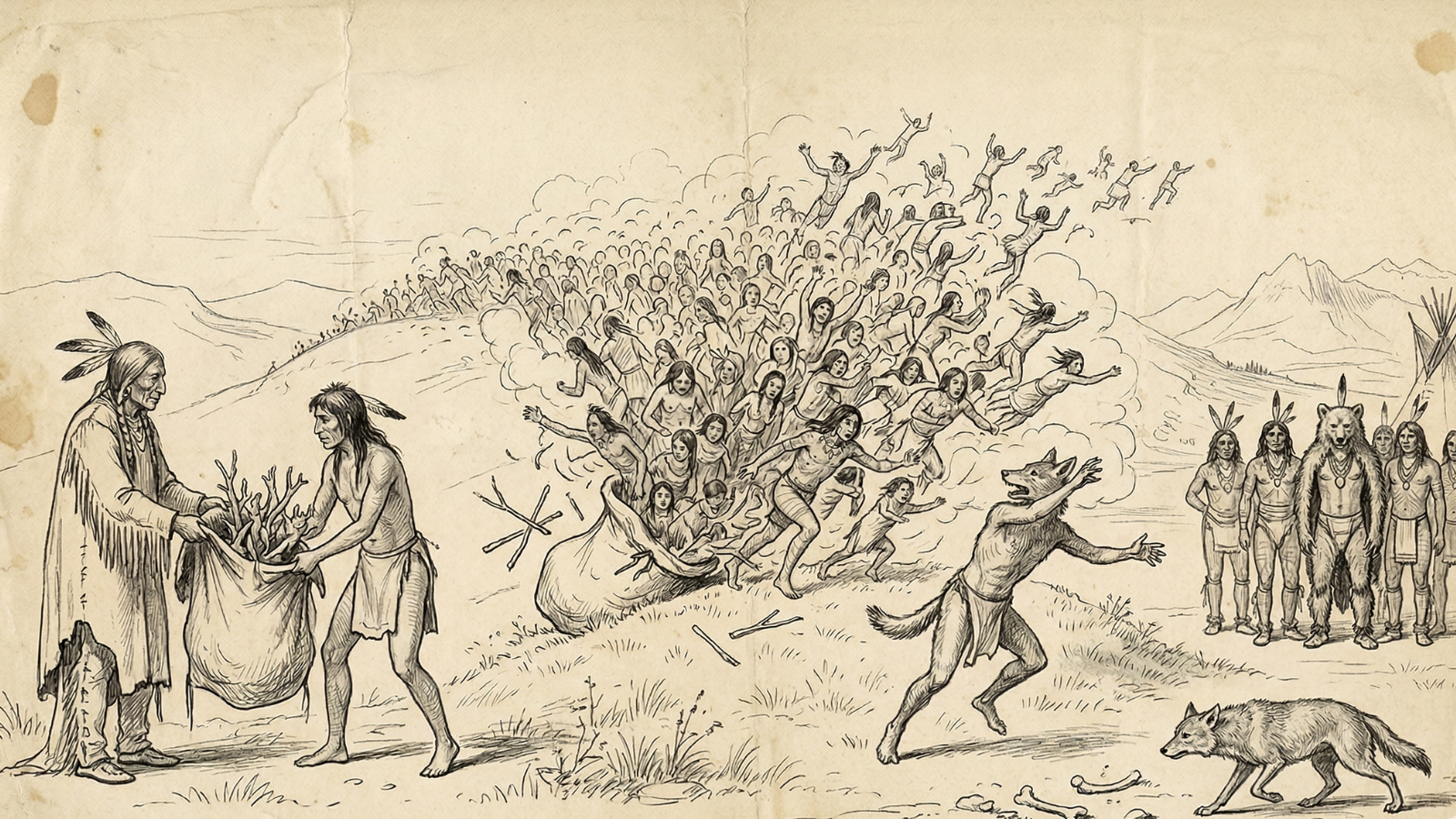
Their story begins with Sinauf, a god who is half man, half wolf. Along with his brothers, Coyote and Wolf, Sinauf kept the world in balance. He made a magical bag and filled it with sticks. All the sticks were different. When placed in the bag, they became people.
Coyote, being Coyote, could not leave the bag alone. He cut a hole in it with his flint knife and peeked inside. When Sinauf threw the bag over his shoulder and began his journey to the high mountain Una-u-quich, the people jumped out of the hole in small groups, scattering across the land, forming families, bands, and tribes. By the time Sinauf reached the mountain, the bag was nearly empty.
The few who remained were the Utes.
Sinawav cursed the Coyote for his meddling. The scattered people would forever war with the chosen ones. But the Utes, though few in number, would be the mightiest and most valiant of heart.
These stories were told in winter, in tipis and wickiups across the valleys of what we now call Utah. Snow drifted in under the walls through little gaps. Children scrambled to cover the drafts. By the fire sat the elder. The storyteller. His listeners sat in a circle, bundled in warm buffalo or rabbit robes, waiting for him to begin what could be a long night of stories. Tales of Sinauf and Coyote and Wolf. Stories that defined the relationship between the Ute and every living thing, both spiritually and physically.
When Europeans arrived 500 years ago, there were at least ten distinct bands of Utes in what is now Colorado and Utah. Those stories were already ancient.
The Bear Dance
Two brothers were hunting in the mountains.
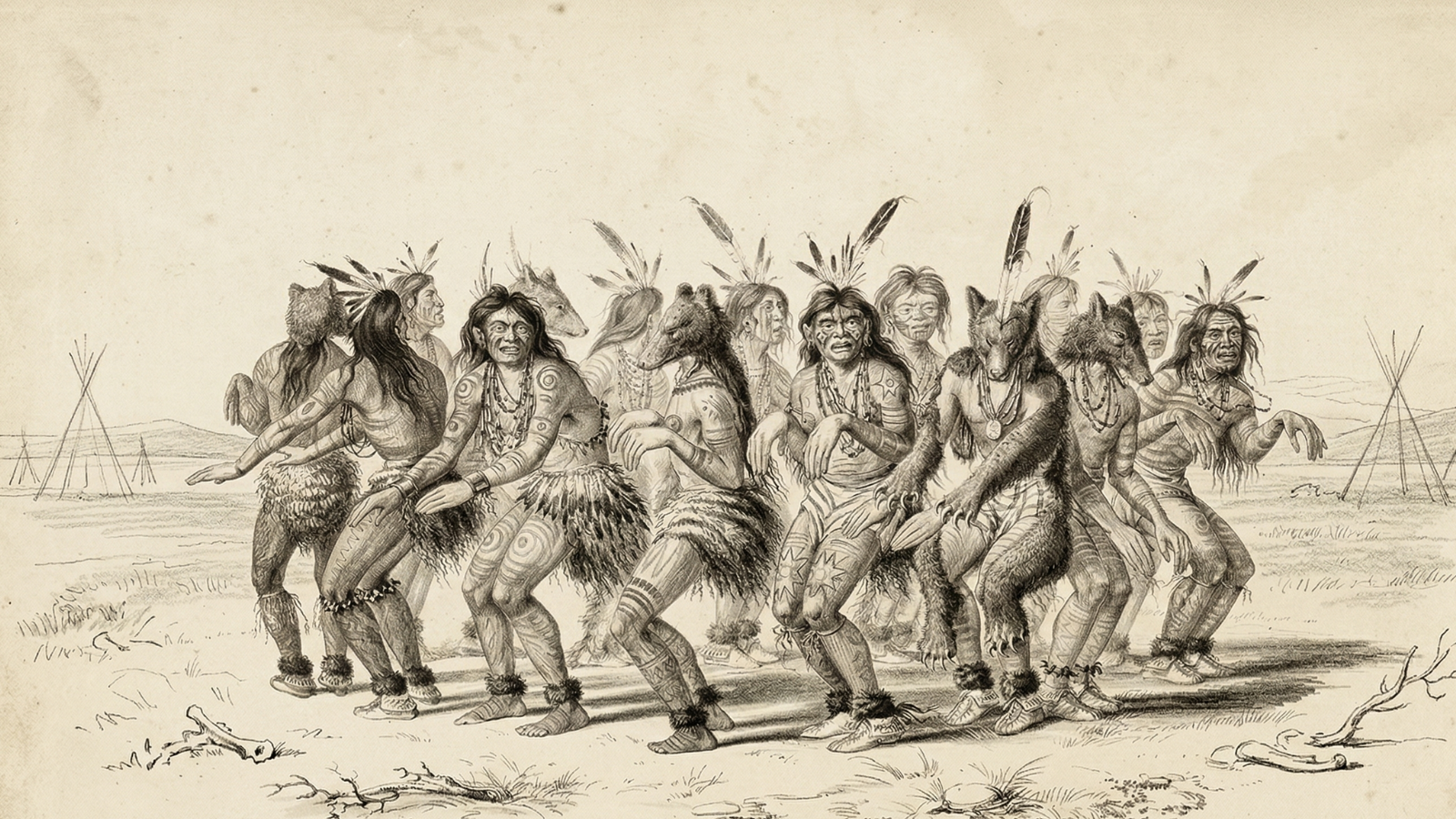
They became tired and laid down to rest. One of the brothers noticed a bear standing upright, facing a tree. The bear seemed to be dancing, making a noise while clawing the bark.
One brother went hunting. The other stayed and watched.
The bear taught the young man to do the same dance. It taught him the song that went with it. Then it told him to return to his people and teach them the dance and songs of the bear.
The songs show respect for the spirit of the bear, and that respect makes one strong. The Bear Dance became the way Ute communities marked the end of winter. Men and women entering the corral wore plumes representing their worries. At the end of the final day, they left those plumes on a cedar tree at the east entrance.
Leave your troubles behind. Start your life anew.
Spanish conquistadors recorded the Bear Dance in the 15th century. Oral tradition places it a thousand years earlier, maybe more. It is a woman's choice social dance. Women select their partners. The back-and-forth step imitates bears scratching a tree. Musicians play notched wooden sticks called morache across resonating boxes, producing a deep rasping sound meant to echo the bear's growl.
The Southern Ute hold their Bear Dance in late May or early June at Ignacio, Colorado. The Ute Indian Tribe of the Uintah and Ouray Reservation holds theirs in Utah. During the COVID-19 pandemic, the 2020 Bear Dance was cancelled. Bear Dance singers performed songs in otherwise empty arenas so tribal members could drive by and hear the traditional chants.
The bear still dances. So do the people.
The World of Wakara
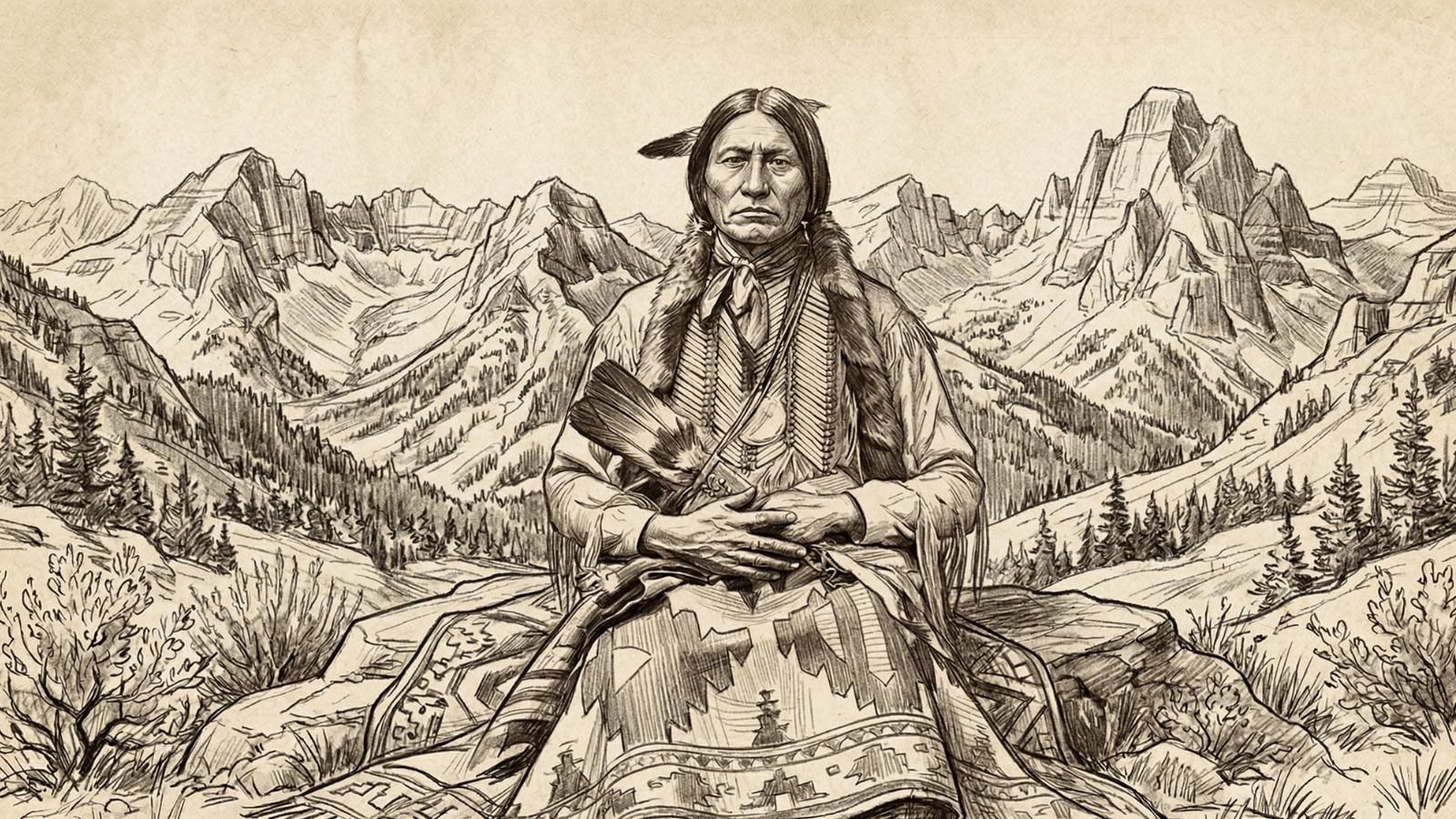
Born around 1815 near the Spanish Fork River in Utah Valley, Wakara grew up at the center of everything. Kinship tied him to other Ute leaders. From his father and older male kin, he learned hunting, horsemanship, and the skills of trade. He spoke Spanish, English, and several Native languages. An observer in 1843 described him as the "principal ruling chief" who owed his position to great wealth. He was a good trader, trafficking with whites and reselling goods to his people.
He was known as the Hawk of the Mountains. The Napoleon of the Desert.
By the 1830s, Wakara had forged an alliance with mountain men such as Thomas "Pegleg" Smith and James Beckwourth. Together they raided settlements for horses at both ends of the Old Spanish Trail, from New Mexico to California. By 1837, Wakara and his followers were becoming wealthy through tribute and trade, and Wakara himself was becoming legendary, often reported in several places at once.
Wakara was also involved in the slave trade that ran through the region. Ute raiders took captives from Paiute and other Great Basin groups and traded them to Spaniards for use in the mines of northern Mexico and the homes of Spanish colonists. Colonial economies reshaped Native power relations, and Wakara operated within that system and profited from it.
In 1847, Latter-day Saint settlers arrived in the Great Salt Lake Valley. For Wakara, the Mormons were initially a convenient and profitable trading relationship. Brigham Young's policy toward Indians was to establish peace through trade and gift-giving.
But settler agriculture, fencing, livestock grazing, timber cutting, and water diversion disrupted game movements and access to key food resources across Utah Valley, Sanpete, Sevier, and the Wasatch Front. The Mormons interfered in the slave trade. In some cases, Mormons refused to purchase children from Ute slavers who would then kill the children. The Utah Legislature passed a law permitting Mormons to purchase Indian slaves and hold them as apprentices for up to 20 years. By the spring of 1853, Mormon restrictions on the trade were causing significant friction with Wakara's band.
On July 17, 1853, several Utes were trading at James Ivie's home near Springville when Ivie intervened in a dispute between a Ute man and his wife. In the fight that followed, Ivie killed one of the men, a relative of Wakara's. Ute tradition called for retribution. The settlers refused.
The Walker War was a string of raids, reprisals, and skirmishes across central and southern Utah from July 1853 to May 1854. Wakara's warriors attacked Mormon outposts in Sanpete Valley, Spring City, and elsewhere. Mormon militias responded. Young instructed communities to build forts and send excess livestock to Salt Lake Valley. They often ignored him.
At Nephi, eight or nine Utes came to a fort seeking protection. A group of townspeople slaughtered them. In at least two cases during the war, Mormons executed unarmed Ute prisoners.
Historians now note that Wakara himself was often hundreds of miles away from the fighting.
In May 1854, Young and Wakara met in person. Wakara said he would prefer not to sell his land if he could live peacefully with the white people, which he was anxious to do. Young refused his demands for the right to trade freely and receive tribute for the occupation of Ute lands. But the two men agreed to peace.
Wakara kept his word. He died of pneumonia on January 28, 1855, near Meadow Creek in central Utah. His body was buried with his goods, including horses.
Historian Max Perry Mueller has argued that Wakara deserves recognition as one of the West's founding figures, alongside Brigham Young. Like Young, Wakara built trade routes, oversaw settlements, and shaped the region's political boundaries. Despite his role in shaping modern-day Utah, Wakara is largely absent from the founding stories we tell ourselves.
The Black Hawk War
In early 1865, starving Utes killed and ate cattle belonging to Mormon ranchers around Manti. The Utes called the meat "Mormon beef." Their hunting grounds had been plowed under. Their pastures had been taken by settler livestock. President Lincoln set aside the Uinta Basin as a Ute reservation in 1861, and most Uintah Utes had been forced onto it by 1864.
On April 9, 1865, the same day Grant and Lee met at Appomattox to end the Civil War, Utes and settlers gathered in Manti to talk. A Mormon settler named John Lowry, reportedly drunk, pulled a Ute chieftain named Arapeen from his horse and beat him. A young Ute warrior named Antonga, known to settlers as Black Hawk, rode away with the delegation, promising revenge.
Over the next few days, Black Hawk and his band raided Mormon homes and ranches, killing settlers and stealing hundreds of cattle. The conflict that followed was the deadliest in Utah's history. An estimated 150 battles, skirmishes, raids, and other military engagements occurred between 1865 and 1872 across Sanpete County, Sevier County, and much of central and southern Utah.
Antonga Black Hawk had been directly involved in earlier conflicts, either as a combatant or coerced to serve as a guide for Mormon punitive expeditions against his own people. His family had been killed at Battle Creek in 1849. Seventy of his kin were killed at Fort Utah in 1850.
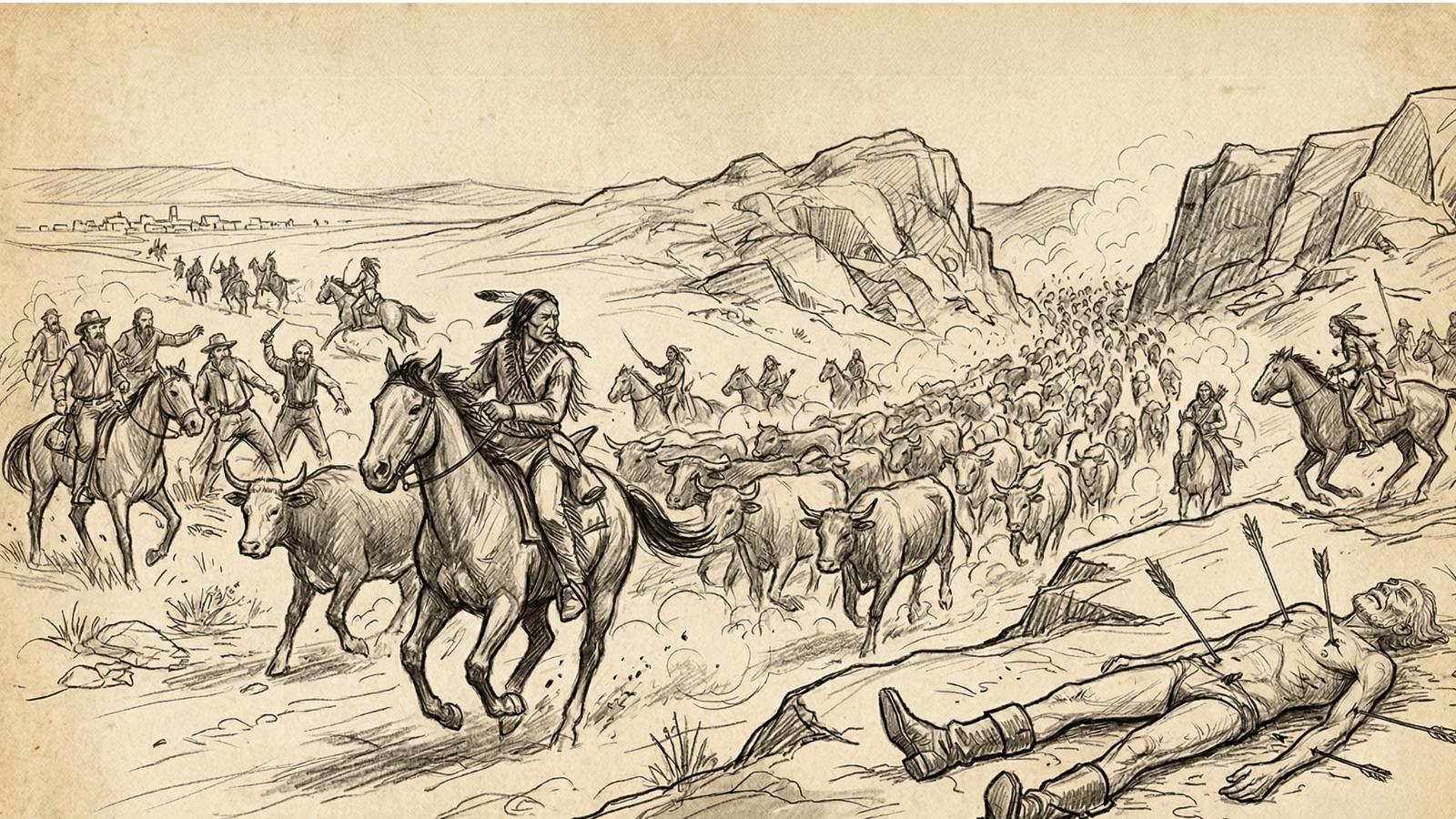
Near Scipio, a band of 100 Utes and allies herded together 350 cattle and 75 horses from surrounding pastures. They killed a 14-year-old herd boy. They shot the elderly James Ivie full of arrows and stripped him of everything except his boots. Ivie's son James had sparked the Walker War a decade earlier. Scipio's men charged out after the herd but were forced back when Black Hawk's rear guard moved to attack the town, which had been left virtually undefended. The Utes drove the livestock through Scipio Gap into Sevier Valley. It was the largest single capture of livestock in the entire conflict.
The Mormon militia pursued. At Gravelly Ford on the Sevier River near Salina, twenty militiamen found sixty Utes guarding the crossing. A prolonged gunfight followed. Black Hawk himself charged the militia line. His horse was shot from under him. He took a bullet to the stomach. The Gunnison militia ran out of ammunition and fled. The Utes drove the herd across the river toward Salina Canyon just as the Richfield militia arrived on horseback to see the cattle nearing the mouth of the canyon. Black Hawk's wound never healed properly and troubled him the rest of his life.
Month after month, the fighting burned across central Utah. Settlers in Fountain Green, Fairview, Moroni, Richfield, Salina, Circleville, Panguitch, and other communities abandoned their towns to fort up elsewhere. Some were never rebuilt.
In Circleville, a friendly group of Paiutes who had nothing to do with the fighting were rounded up and locked in a building. Two broke free and were shot. Then the settlers decided to kill the rest. They were led out one at a time. Twenty-six people. Women and children among them. Brigham Young reportedly said that the curse of God rested upon Circle Valley and its inhabitants because of it.
Black Hawk died on September 27, 1870, near Spring Lake, and was buried by his tribe in a nearby ravine. Young called him the most formidable foe the pioneers had encountered in many years. By the time federal troops intervened in 1872, 51 settlers had been killed and 25 settlements abandoned across five counties. The Native dead went largely uncounted.
The Meeker Crisis
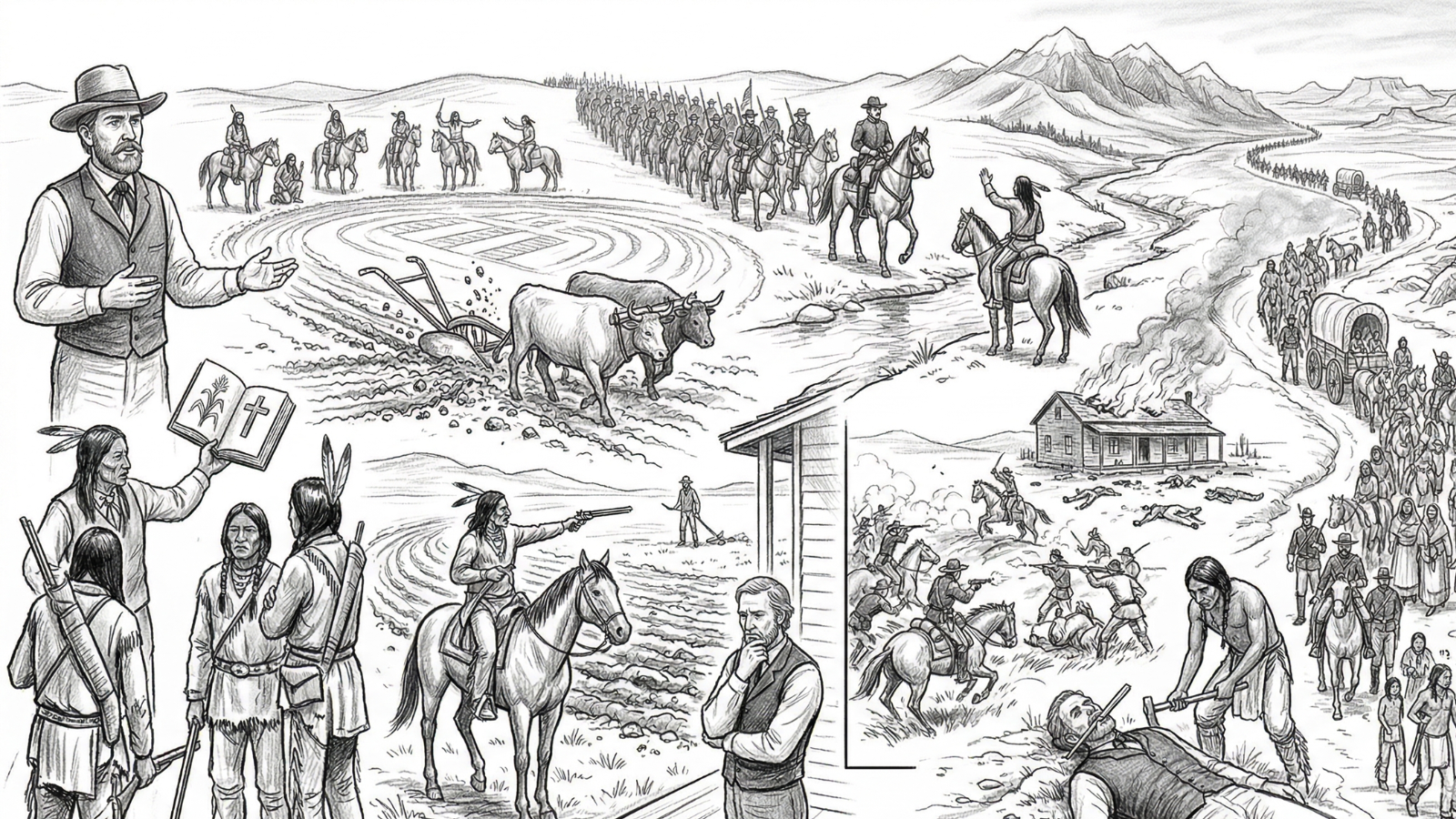
By 1878, the White River Utes in northern Colorado received a new Indian agent: Nathan Meeker. Meeker wanted the Utes to become Christians and farmers. They preferred to hunt. Meeker decided to force the issue.
In early September 1879, he ordered the plowing up of their horse racing grounds. Horse racing was central to Ute culture. The plowing was seen as a desecration of the land. An unidentified Ute man shot at an agency plowman to stop it. A heated council followed. A physical confrontation between Meeker and the Ute leader Johnson ended with Meeker calling for military protection.
Major Thomas Thornburgh left Fort Steele with around 140 soldiers. As they approached Milk Creek, the reservation boundary, the Ute leader Jack demanded to know what the soldiers intended. Thornburgh continued his march. Jack rode back to the agency.
Soldiers were ambushed at Milk Creek. Thornburgh was killed. At the agency, Meeker and several others were killed. Meeker's body was found with a stake through his mouth. So he could tell no more lies.
The rallying cry in Colorado newspapers became "The Utes Must Go." The White River and Uncompahgre Utes were removed from Colorado and relocated to the Uintah Reservation in Utah. The Uncompahgre band, which had nothing to do with the fighting, was removed alongside the White River band, which did.
The Flight
After the removals, the government allotted the Uintah and Ouray Reservation. The land was carved into individual parcels of 80 to 160 acres per person. Everything else was declared surplus and opened to white settlement. Ute land holdings were reduced by over 85 percent.
In the spring of 1906, between 300 and 700 White River Utes left the reservation and headed north. They told settlers they were going to a northern reservation where a great gathering of western Indians had been arranged to council over their grievances. They freely expressed their determination to fight rather than return.
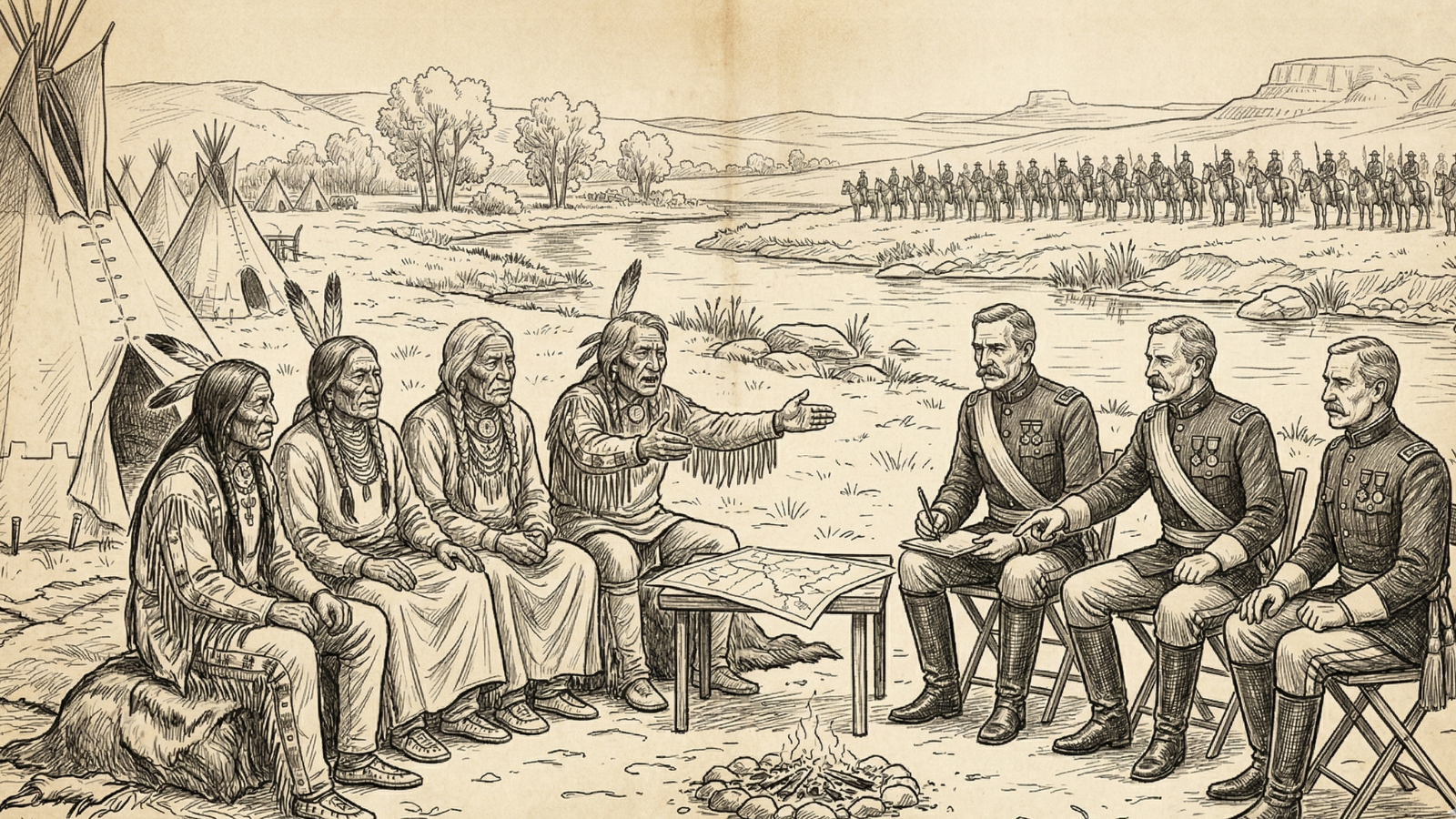
Their progress across Wyoming made national headlines. White residents armed themselves. The government assembled over a thousand soldiers. The War Department called it necessary to "overawe" the Utes.
On Powder River, the talking lasted twelve hours. Several times, the Ute negotiators returned to their camp. The soldiers could do little but wait. Each time negotiations resumed, the Utes refused to return.
They were escorted to Fort Meade, South Dakota, where the Army fed them through the winter. A delegation traveled to Washington in January 1907 and met with President Roosevelt. They made clear they would not return to Utah. Roosevelt expressed sympathy but told them they must work if they planned to stay.
In March, a message from the president arrived: they must go back. The Ute leader Red Cap said he would not go back without a fight.
They were returned.
A hundred years later, in May 2006, a group of 30 Ute tribal members traveled from the Uintah and Ouray Reservation to South Dakota to mark the anniversary. They visited Fort Meade and the Thunder Butte area on the Cheyenne River Reservation. Nine graves of Utes who had died there a century earlier had been found just two days before.
Maria Cuch, one of the Utes who made the trip, said she learned from Sioux tribal records that there was more to the story. She never knew that the Sioux had cared for their people. Not just in historical times. But to that day.
Today, three federally recognized Ute nations maintain sovereignty, manage land and resource interests, and continue cultural traditions including ceremony, language, and community governance: the Ute Indian Tribe of the Uintah and Ouray Reservation in Utah, the Southern Ute Indian Tribe, and the Ute Mountain Ute Tribe.
The Bear Dance still happens every spring. The stories of Sinauf and Coyote are still told.
The state bears their name.


