


On July 13, the National Collegiate Basketball Hall of Fame announced its Class of 2026: coaches Jay Wright, Tubby Smith, and Ted Owens, and players Glen Rice, the late Walt Hazzard, and Danny Ainge.
The induction is on October 22 at the College Basketball Experience in Kansas City, Missouri. Devin Durrant, who played alongside Ainge in Provo, told the Deseret News the recognition was "long overdue,".
On BYUtv's Sports Nation, hosts Jarom Jordan and Jason Shepherd wondered what criteria could keep a national player of the year out for 45 years.
The question has an answer, or at least the outline of one, and it starts with how strange the wait actually was.
The case for Ainge was complete by the spring of 1981. Per the NABC's release, he scored 2,467 points at BYU from 1977 to 1981, averaged 24.4 points per game as a senior, and scored in double figures in 112 consecutive games, a record at the time. College basketball would not adopt the three-point line until five years after he left.
BYU's athletic department lists the honors: the 1981 John Wooden Award as national player of the year, consensus First Team All-American, two-time First Team Academic All-American, and WAC Player of the Year.
As a senior, Ainge carried BYU to the only Elite Eight in program history, scoring 37 against UCLA in the second round, still tied for the most by a BYU player in an NCAA Tournament game, and then going the length of the floor in the final seconds to beat Notre Dame two days later.
Ask a BYU fan of any age to name the greatest play in program history, and that's the one they'll name.
The hall opened 25 years later, in 2006, created by the National Association of Basketball Coaches and housed inside the College Basketball Experience next to Kansas City's T-Mobile Center. It inducted a founding class of roughly 180 people that November, about 100 of them players, and has added a class most years since.
The Class of 2026 is its 20th.
The Wooden Award, awarded to a national player of the year since 1977, serves as a useful measuring stick, and the hall publishes its full membership by induction year. Hence, the comparison is just a matter of reading the list.
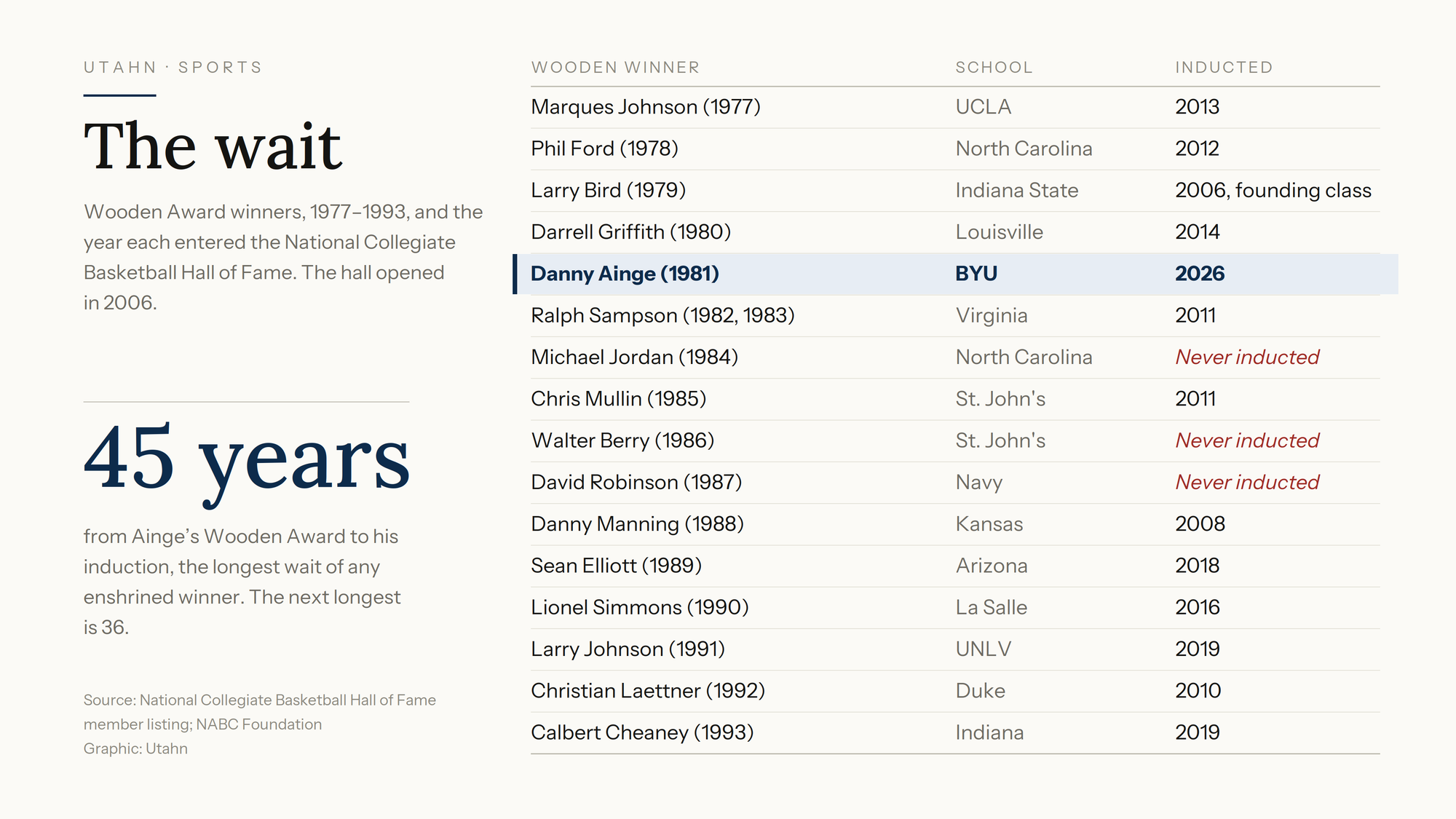
Every Wooden winner from the award's first 17 years who has been inducted got in during the hall's first 13 selection cycles, between 2006 and 2019. Ainge got in on cycle 20. The committee passed on him at least six more times than on any inducted peer, in years when it found room for Todd Lichti, Jim Jackson, and Richard Hamilton, and in 2024, when the entire class was posthumous.
The 45 years between Ainge's Wooden Award and his induction are the longest such gap for any player who has actually been enshrined. The next longest belongs to Marques Johnson, at 36.
The only Wooden winners who have waited longer are the ones still waiting. Michael Jordan is not in the college basketball hall of fame. Neither is David Robinson. Neither is Walter Berry. Their college careers are not the problem, obviously. What the three have in common is that none of them ever worked in college basketball again after leaving it, and for 20 years, the same was true of Ainge.
The hall's stated mission is to enshrine greats who deserve recognition but may be omitted from the Naismith Memorial Hall of Fame in Springfield. Selection runs through a Blue Ribbon Selection Committee of college basketball executives, administered by the NABC Foundation. The hall holds no public ballot and announces no finalists. Nominations, if they are tracked at all, are not published.
Classes run small, usually with two to seven players a year. A process built that way tends to favor candidates the committee's members know personally, and candidates who can be counted on to show up for the induction dinner.
Ainge was neither. He left Provo for the Celtics in 1981. He spent the next four decades in the NBA as a player, a coach, a broadcaster, and then an executive, running Boston's front office from 2003 to 2021 and taking over basketball operations for the Jazz within months of leaving. He never coached a college team or held any position in the sport that was now deciding whether to honor him. The committee's world and Ainge's world stopped overlapping in 1981.
Two things changed.
BYU joined the Big 12 in 2023. The Big 12 Tournament is played at T-Mobile Center, which shares a block with the hall, so every March since then, BYU's administrators, donors, and traveling fans have spent a week next door to a museum whose only Cougar was Krešimir Ćosić, a founding-class member who died in 1995. BYU's student paper toured the hall during this year's tournament and wrote that Ćosić stands alone and that it was hard not to imagine who might join him. Four months later, the hall announced Ainge, in a class that also honors Ted Owens of Kansas.
Ainge's calendar opened up, too. His son Austin now works in the Jazz front office, a hire Durrant credited to Ryan Smith in the Deseret piece, and for the first time since the hall opened, an October evening in Missouri looks like something Danny Ainge can commit to.
Neither explanation flatters the process. His credentials did not change between 2006 and 2026; his proximity did. Whether the hall finally found Ainge or Ainge's world finally drifted within sight of the hall is unknown.
The induction arrives on a campus already arguing about where Ainge ranks. The Sports Nation hosts noted that Syracuse transfer Tyler Betsey had posted a poll from the Marriott Center trophy cases asking fans to choose between Ainge and Jimmer Fredette as the better national player of the year. The hosts declined to choose, sketching a Mount Rushmore of Ćosić, Ainge, Fredette, and AJ Dybantsa instead, though they allowed that Ainge is the most accomplished of the four. It is hard to argue. He was a high school All-American in three sports and played parts of three Major League Baseball seasons for Toronto while still enrolled at BYU, a detail that gets stranger the longer you sit with it.
Notre Dame plays at LaVell Edwards Stadium on October 17, the program's first trip to Provo since 2004. Ainge's induction is five days later. Forty-five years after he went coast to coast to beat the Irish, they come to town the same week he enters the hall.
The Sports Nation hosts suggested BYU hand Ainge the flag and let him lead the football team out of the tunnel. It's a good idea, as far as we're concerned.
What are we missing? What did this piece get wrong? Email me at clint@utahn.com.
AI tools were used in the production of this article. Utahn uses AI to read documents, assemble data, and conduct deep research. Every piece is reported, written, and edited by a Utahn journalist. Read more about how we use AI.


