


For more than a decade, as CEO of Silicon Slopes, I’ve had a front-row seat to Utah’s transformation into a global tech hub with all of the benefits and challenges that have come with it. There’s been plenty of both; more on that in a moment.
When we started Silicon Slopes, the mission was clear: attract capital, talent, and awareness to Utah’s tech industry. Mission accomplished. Let’s hang a banner, George W. Bush-style.
So what happens when you’re running an organization after the mission has been accomplished? It’s a complicated question, one that too few organizations, particularly nonprofits or NGOs, think hard enough about.
There’s a reason they don’t. In the process of accomplishing its mission, a successful organization would have accumulated resources, an engaged community, an influential network, “power” amongst its leaders, and a recognizable brand with significant equity. It’s not easy to walk away from something like that.
But the truth is, once the mission has been accomplished, you really only have two options: 1. Shut it down. 2. Change the mission.
Silicon Slopes spent considerable time weighing Option 1 but ultimately chose Option 2. We came to understand that the organization was uniquely positioned to ensure Utah remains the best place in the world to start, grow, and scale a company. That’s the new mission. And we do this by surrounding entrepreneurs of all stripes with everything they need to succeed: community, education, mentorship, and world-class events.
In February, we launched Start School, the cornerstone of this new mission. Start School is a first-of-its-kind entrepreneurship program powered by the aforementioned infrastructure that Silicon Slopes has built over the past decade. We don’t take equity, charge tuition, or invest in any of the companies in the program. It’s open and accessible to all Utahns.
Think of it as entrepreneurship for the 99%. Rather than having to know someone on the inside who may or may not make an introduction to someone else on the inside, you get into the program by filling out an application that proves you’re building a real company (any company, not just software) and are capable of getting a Mountain America Credit Union business checking account.
Once you’ve done that, you just have to agree to follow Start School’s two rules: 1. Show up. 2. Give more than you take. It’s that simple.
Since its launch, more than 450 companies have joined Start School, with an average of 25 companies applying daily. That’s insane. We expected to have around 50 companies at this point. One could look at those numbers and conclude this only happened because Silicon Slopes is so amazing, but the reality is more complex and should likely be seen as a flashing yellow light, warning anyone who cares to notice of what’s to come.
This isn’t about Silicon Slopes. It’s about the future of work and where the economy is headed.
Many of the entrepreneurs in Start School currently have high-paying jobs and well-established careers. Under normal circumstances, there would be no reason for them to want to start their own business. We’re not living under normal circumstances.
AI has changed everything.
What the heck is happening?
The leaders of the frontier AI labs (Anthropic and OpenAI, specifically) have marketed their products in a way that I’ll unflatteringly summarize as follows:
“We’ve built something that is going to take your job. And not just your job, everyone’s job. We’re going to become the richest, most powerful individuals and companies in the history of the world. Hopefully, if you do what you’re told, the government will mail you a check every month to pay your bills. Isn’t technology cool? Best of luck!”
Somehow, only God knows how, they’re surprised the public received their message negatively. The polling on AI isn't close. A Pew Research Center survey found that half of America is more concerned than excited about AI. 10 percent say the opposite. About two-thirds say the technology is advancing too quickly. Only 2% (!) say it’s moving too slowly.
An NBC News poll in March found that 57% of American voters believe the risks of AI outweigh the benefits and rated the technology below President Trump, below ICE, and below the Republican Party. The only things Americans rated lower in that poll were the Democratic Party and Iran.
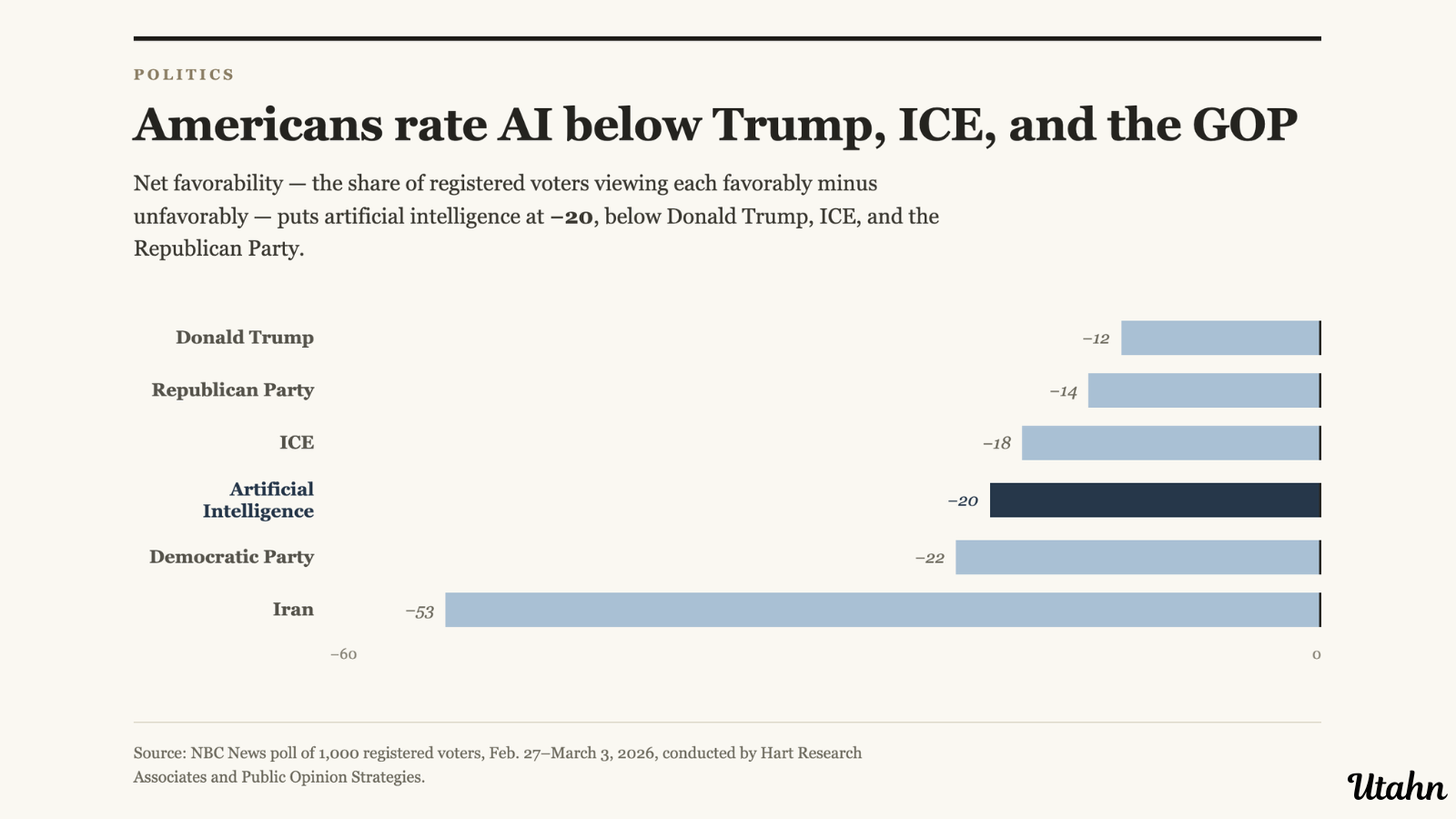
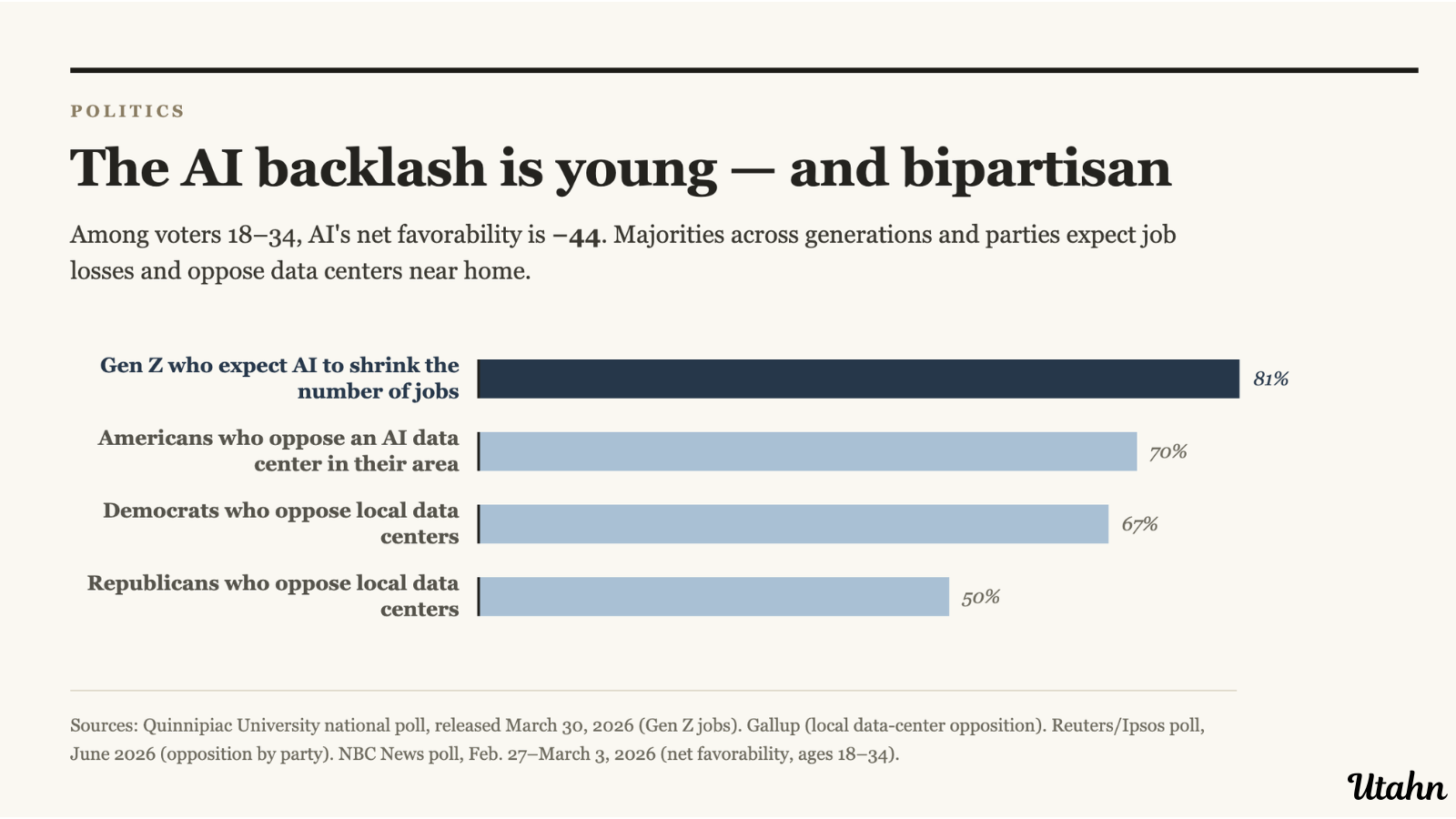
Among voters ages 18 to 34, AI's net favorability is -44. A Quinnipiac poll the same month found 81% of Gen Z expect AI to shrink the number of jobs. So, of course, during college commencement speeches this spring, tech luminaries were met with boos at the mere mention of AI. Why were they surprised? Again, only God knows.
Opposition to data centers, which continues the overall anti-AI trend, is also bipartisan and overwhelming. Gallup found 7 in 10 Americans oppose an AI data center in their own area, and a Reuters/Ipsos poll in June found that opposition holds among two-thirds of Democrats and half of Republicans. Utahns who followed the Stratos fight already know what those numbers look like in real life.
For scale, consider the least popular and least useful institution in American life. In April, Gallup measured congressional approval at 10%, one point above its all-time low. AI is not there. But Congress has been despised for 50 years, and its numbers never really move. AI's numbers are new. And they’re moving in one direction.
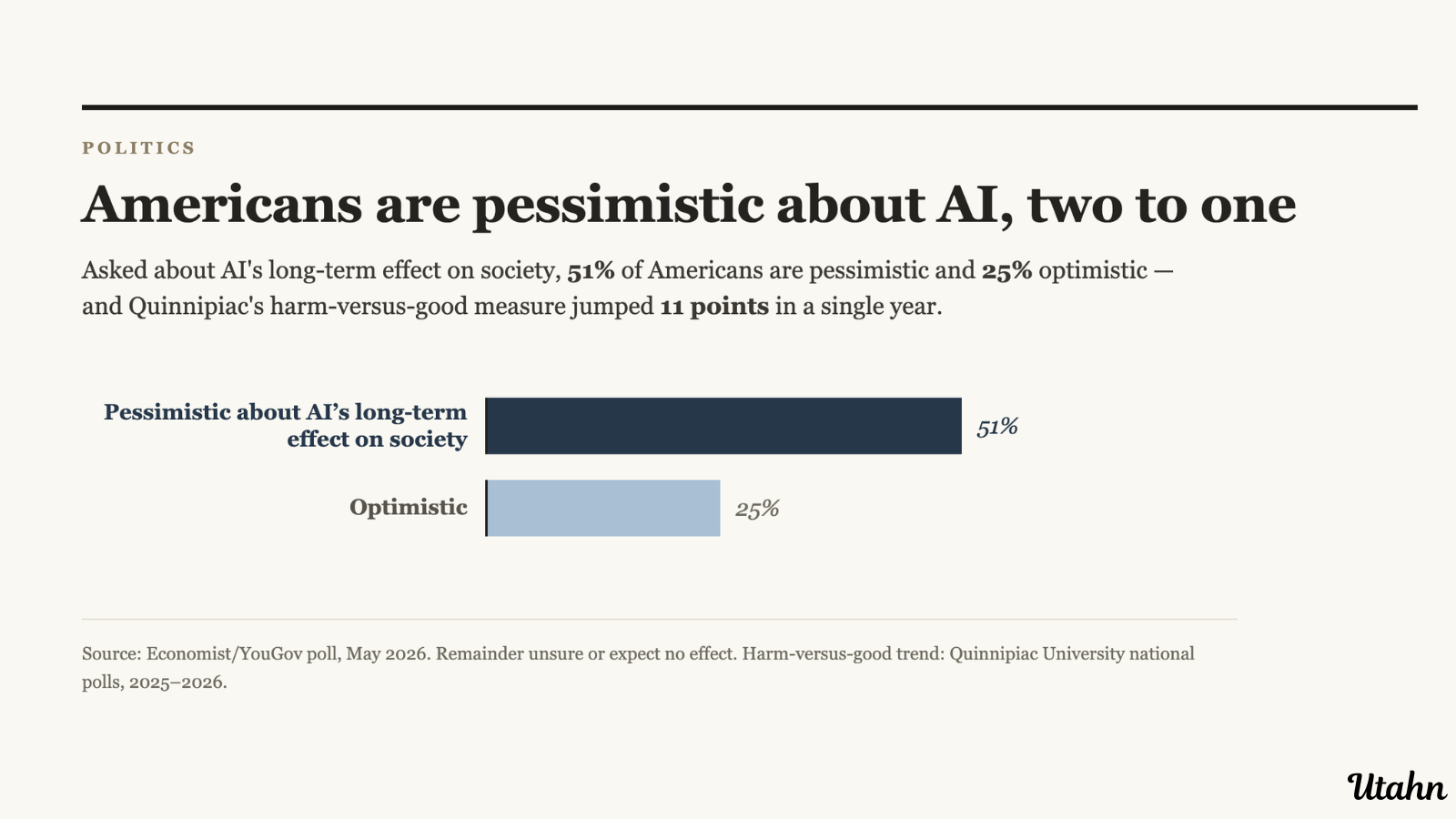
A May Economist/YouGov poll found twice as many Americans were pessimistic as optimistic about AI's long-term effect on society, 51% to 25%. Quinnipiac's harm-versus-good number jumped 11 points in a single year. No consumer technology in the polling record has fallen this far this fast while people were still adopting it.
And, paradoxically, they are adopting it. Pew found that about half of American adults now use AI chatbots, a quarter use them daily. They don't believe what AI tells them, of course. Quinnipiac found 76% trust AI-generated information hardly ever or only some of the time.
Congress lost its persuadable middle a generation ago. AI still has one, about 38% of the country, pulled equally between excitement and freaking the oh-my-goodness out, waiting to see.
We’re living in a crisis of leadership. At the political level, sure, but we’ve known that our entire lives. That’s like saying the sky is blue or the NBA hates the Utah Jazz. We know. The crisis of leadership I’m talking about lies with our AI overlords.
When Henry Ford put America on wheels, he didn’t tell the public motor vehicles were going to take all of their jobs or create an economic crisis the likes of which humanity had never seen. Of course not. Why would he? It wasn’t true. Want to hear something crazy? It’s probably not true when it comes to AI either.
The Yale Budget Lab has analyzed the labor market month by month going back to ChatGPT's launch and found no discernible disruption at the economy-wide level. Occupational churn is flat, sitting within historical ranges. A study of Denmark covering 25,000 workers and 7,000 firms found no significant effect on wages or hours. Anthropic's own economists reached the same conclusion for American workers in the most exposed occupations, though they flagged early signs of slower hiring for the youngest workers.
What gives? Why is the data showing one thing, and the very people bringing this technology to market saying another?
Silicon Valley is transferring wealth
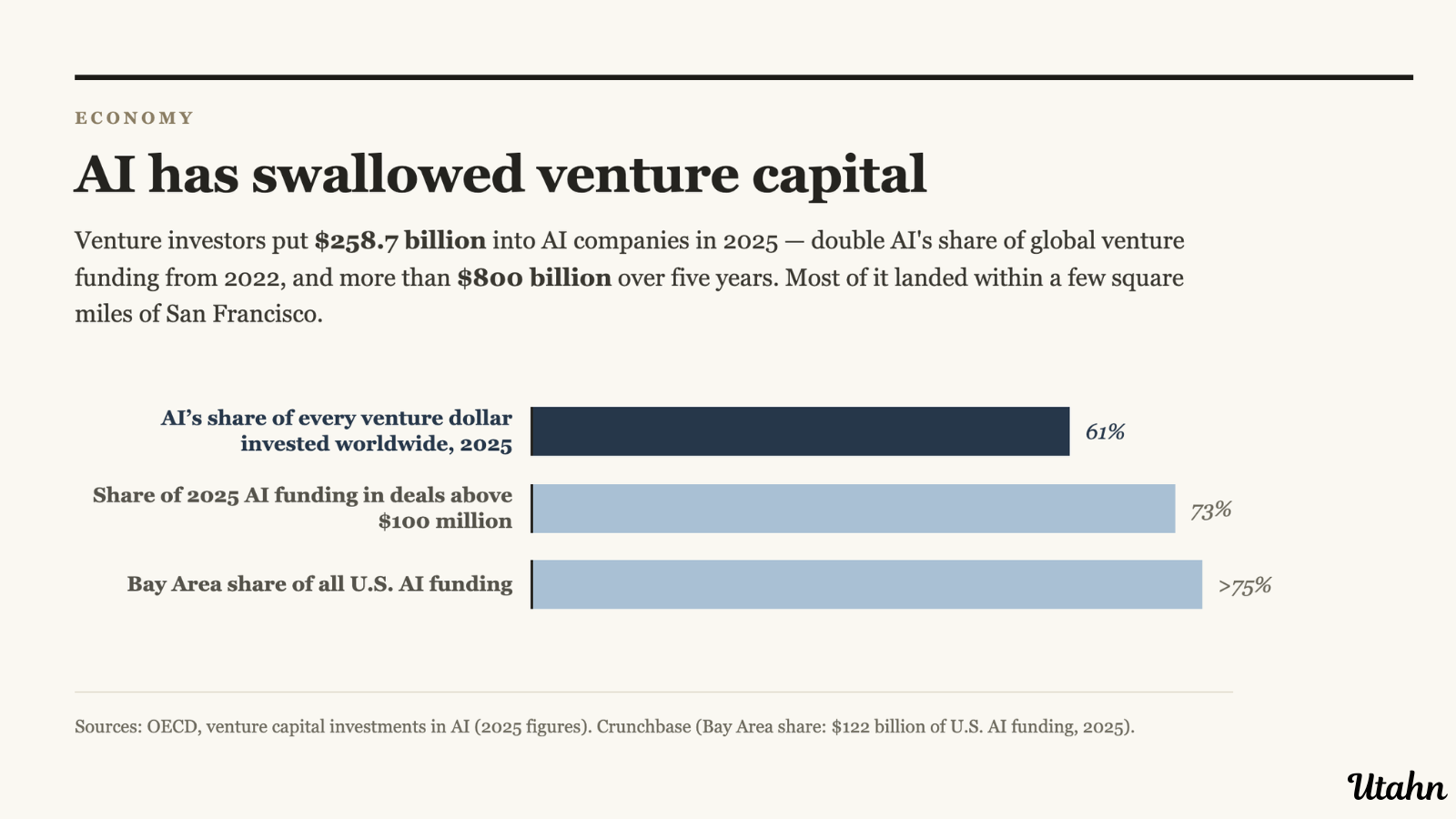
In 2025, according to the OECD, venture investors put $258.7 billion into AI companies. That’s 61% of every venture dollar invested anywhere on earth, double AI's share from 2022, and when you add up the OECD's annual figures for the past five years, the total runs well past $800 billion.
Now, let’s do what my wife has never said and get downright freaky. Deals above $100 million accounted for 73% of last year's figure. Most of it landed within a few square miles of San Francisco. Crunchbase data shows the Bay Area alone raised $122 billion in 2025, more than three-quarters of all AI funding in America.
While that capital flowed in, the enterprise software market bled out. In late January, investors began to believe AI agents could perform the work that enterprise software companies sell by the seat, and they decided that the incredibly efficient and profitable model built over the last two decades was in trouble. Wall Street called the sell-off the SaaSpocalypse, a word that should embarrass anyone who’s typed it. I know I’m embarrassed.
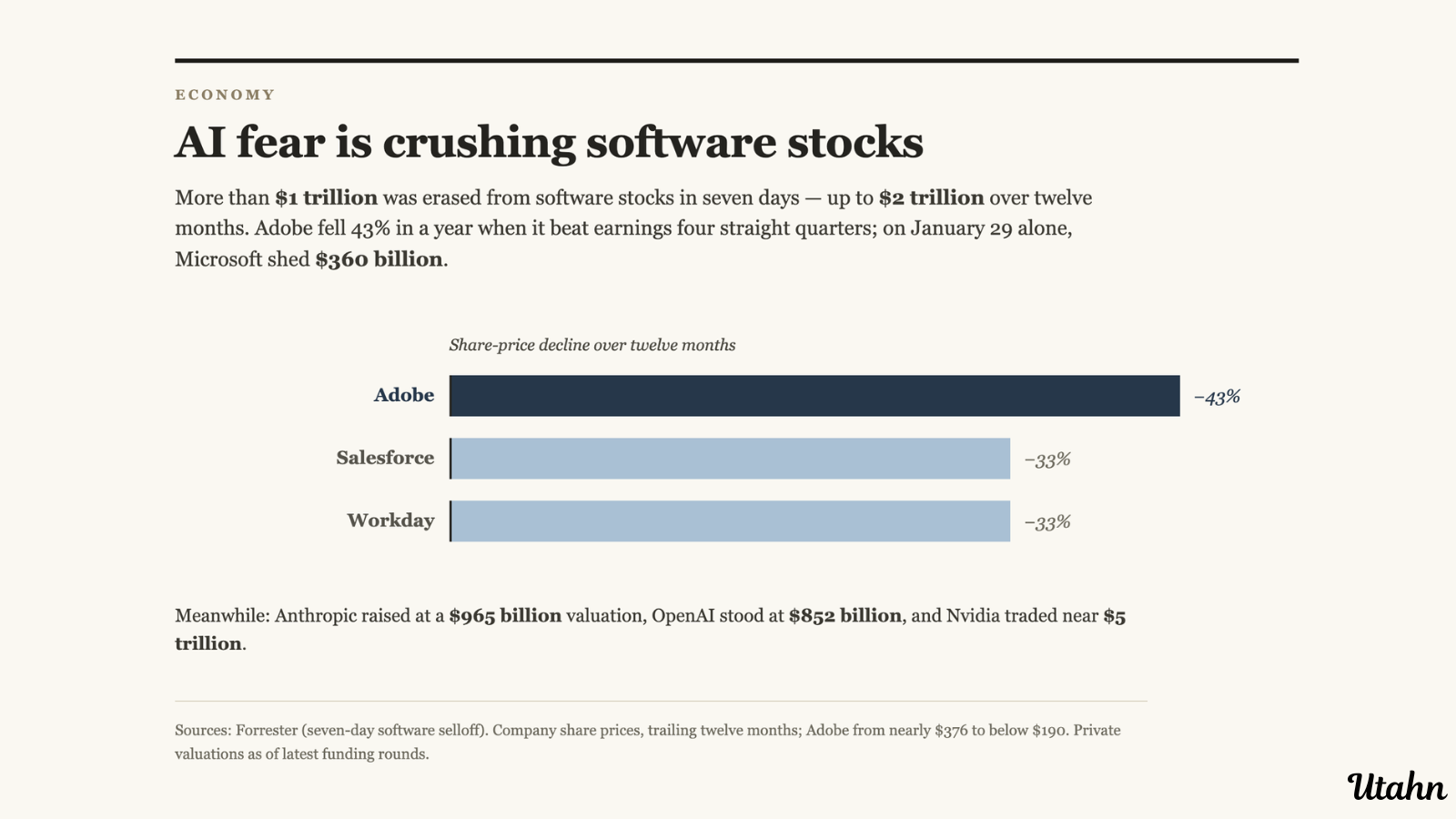
Forrester counted more than $1 trillion erased from enterprise software stocks in seven days. Broader estimates run to $2 trillion over twelve months. Adobe fell from nearly $376 a share to below $190, a 43% drawdown in a year when it beat earnings four straight quarters. Salesforce and Workday each lost roughly a third of their value.
On January 29, Microsoft shed $360 billion in one day. In the same stretch, Anthropic raised at a $965 billion valuation, passing OpenAI at $852 billion, and Nvidia traded near $5 trillion.
So that’s what gives. Silicon Valley is transferring money from one group to another. To sell investors on their products, Anthropic, OpenAI, and other frontier AI companies have to convince investors that the products they’re building will replace existing ones.
The impact on Silicon Slopes
This matters to Utah. A lot. Utah is one of the best tech hubs in the world at building enterprise software companies. The most frequently asked question within the Silicon Slopes community right now is whether this trend will continue or whether the market has overhyped AI, particularly the assumption that it will replace enterprise software and the companies that sell it.
Basically, the question boils down to whether there will be only 10-15 tech companies in the world, or whether we’re about to see a massive correction. I’d bet on a correction, but I’m not an economist or financial advisor. I run a small nonprofit in Utah. Requisite caveats out of the way, here’s my case for a correction:
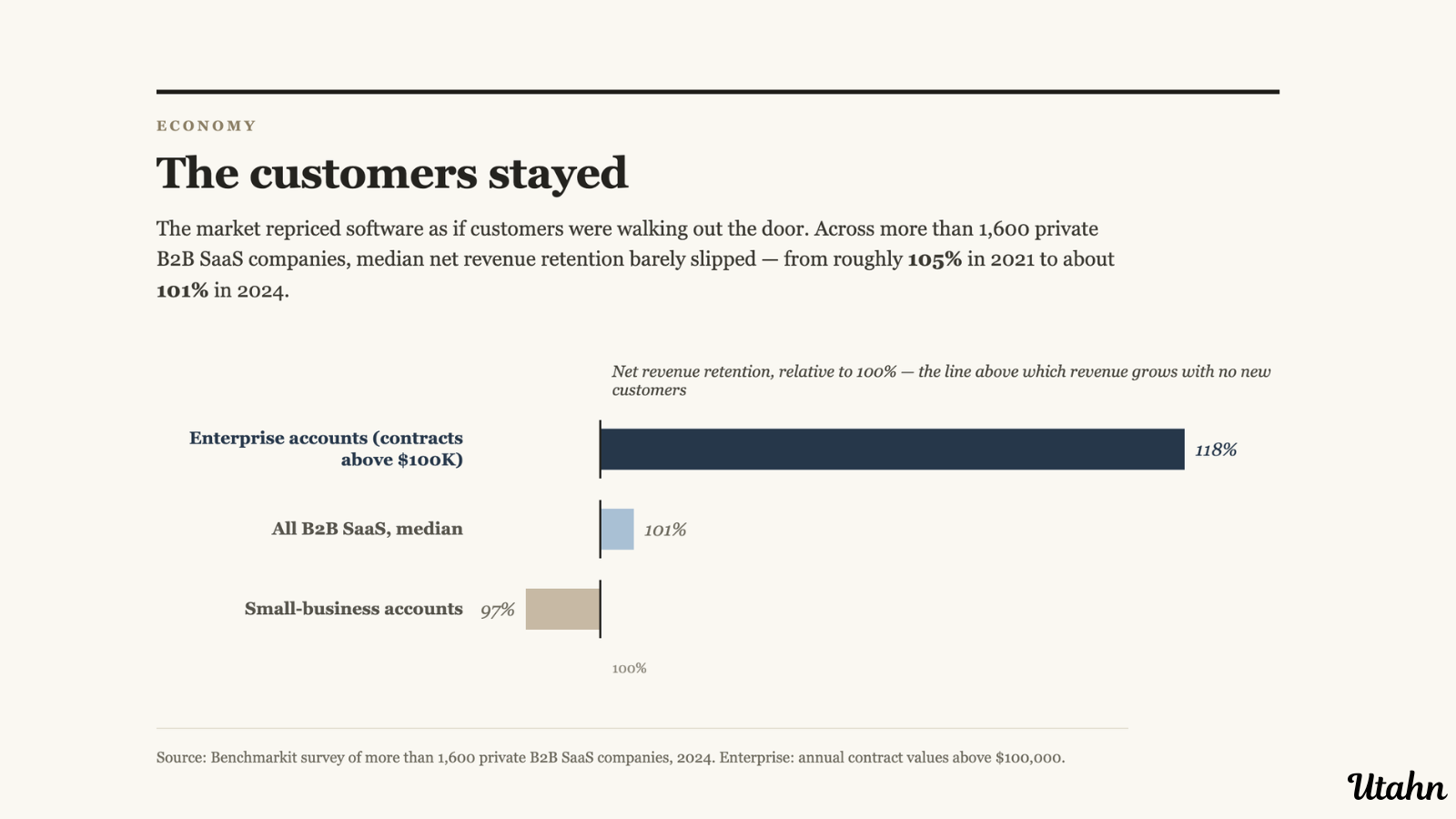
The market repriced software as if customers were walking out the door, but the actual retention data show they’ve stayed. Across private B2B SaaS, median net revenue retention barely slipped from roughly 105% in 2021 to about 101% in 2024, according to Benchmarkit's survey of more than 1,600 companies.
A company at 101 percent still grows without signing a single new customer. The average also hides a split. Enterprise accounts with contract values above $100,000 have retention near 118%, while small business accounts are at 97%. Big companies are simply not ripping out their secure, stable, regulatory-compliant systems of record in exchange for something that’s been vibe-coded.
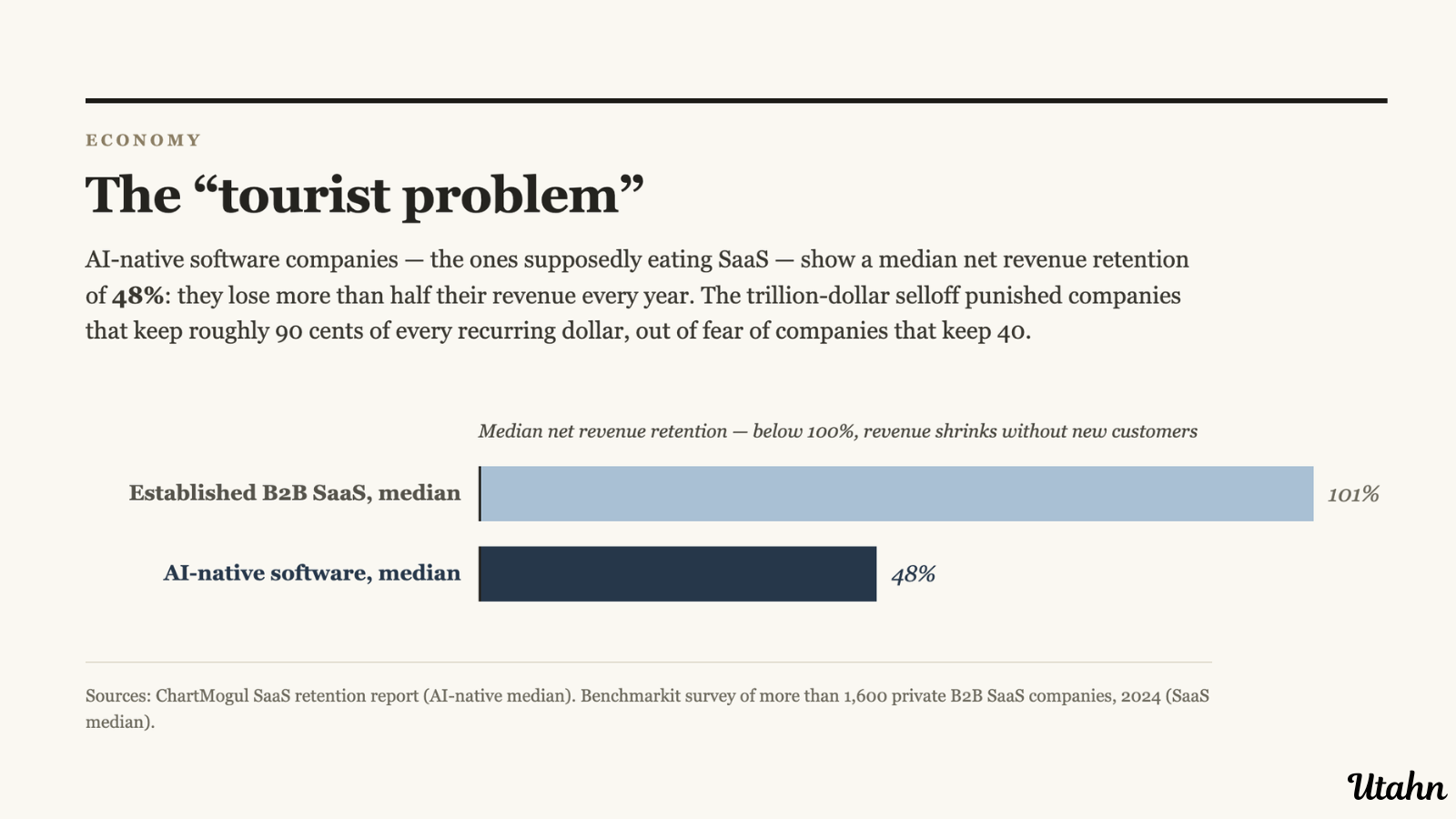
ChartMogul's retention report found that AI-native software companies, the ones supposedly eating SaaS, show a median net revenue retention of only 48%. They lose more than half their revenue every year. ChartMogul's Kyle Poyar calls it the "tourist problem." People sign up out of curiosity, then leave when the novelty wears off.
Yet the disconnect between prices and renewals persists: ServiceNow dropped 11% in a day after beating earnings for the ninth straight quarter, and Adobe hit a 43% drawdown even as it beat expectations for four straight quarters.
The trillion-dollar selloff punished companies that keep roughly 90 cents of every recurring dollar, out of fear of companies that keep 40 cents. I don’t know much, but I know that’s not sustainable.
The state of venture capital in Utah
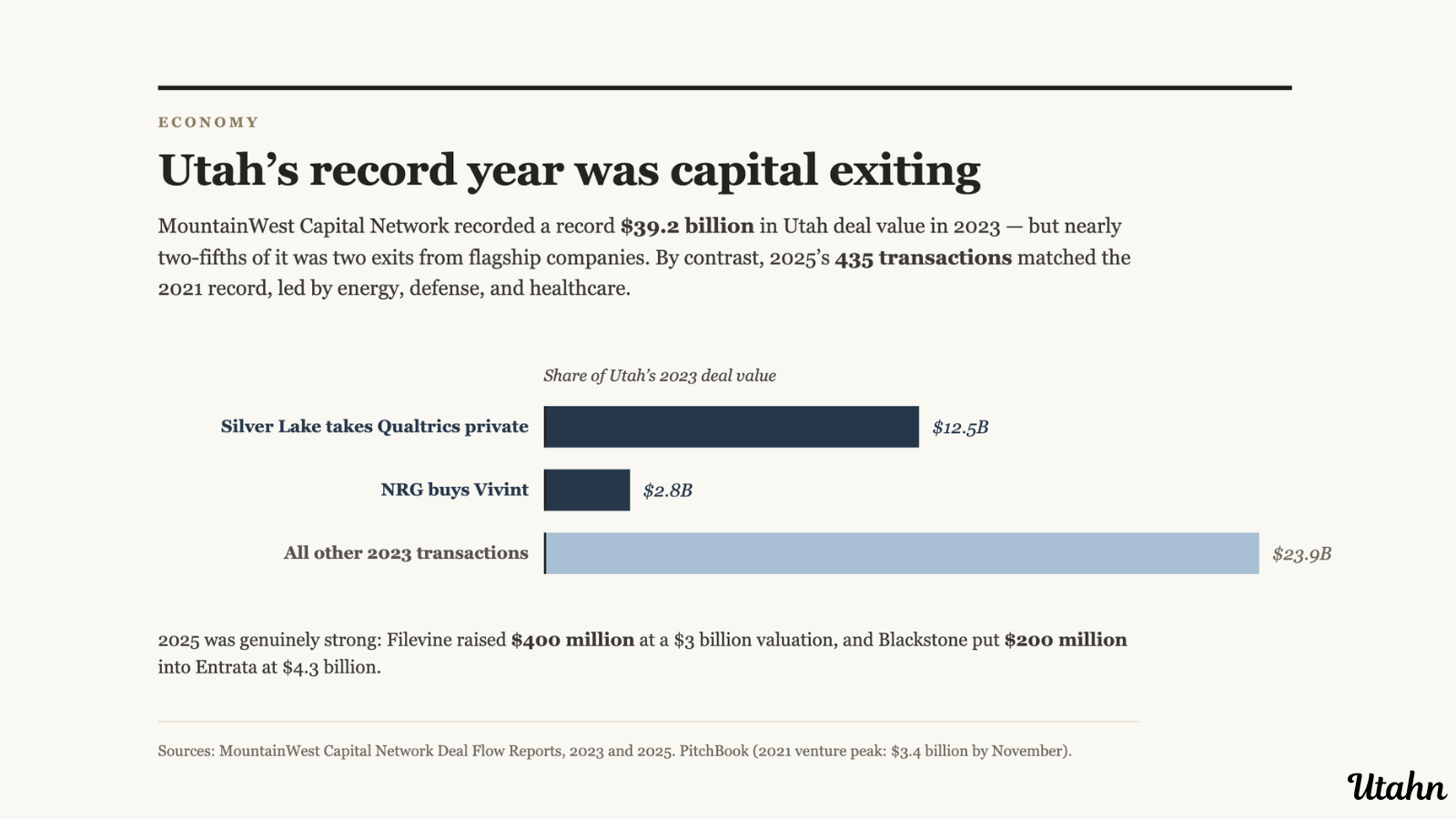
PitchBook reported $3.4 billion in investment in Utah companies by November 2021, the peak. The MountainWest Capital Network recorded a record $39.2 billion in deal value in 2023, but that record was driven by Silver Lake taking Qualtrics private for $12.5 billion and NRG buying Vivint for $2.8 billion. Our biggest year was capital exiting our flagship companies.
2025 was genuinely strong. Filevine raised $400 million at a $3 billion valuation. Blackstone invested $200 million in Entrata at a $4.3 billion valuation. Local funds grew, and MWCN's latest Deal Flow Report counted 435 transactions, matching the 2021 record, with the money going to new destinations. Energy, defense, and healthcare now lead the state's deal flow. Enterprise software, which once accounted for more than half of Utah's venture deals, is now one category among many.
Utah's dollars have held. Its share has not. When 61% of global venture capital goes to AI, and nearly all AI capital goes to the Bay Area, a state can match record deal counts and still shrink. The Gardner Institute ranks Utah at the top among states for innovation capacity yet still names venture capital as a gap. We simply don’t have anywhere near the amount of venture capital that other tech hubs, particularly Silicon Valley, have to invest in market-creating AI companies.
Then there’s the talent question. In an interview with Upstarts Media, Filevine CEO Ryan Anderson said, "There probably isn't enough talent to build a world-class AI company in Utah." He does say it can be built. The questions are how we do that, and whether we even want to try.
The benefits and challenges
At the beginning of this article, I promised I’d delve deeper into the benefits and challenges accompanying Utah’s emergence as a global tech hub. Let’s start with the benefits because they're massive. Since 2010, Utah's tech cluster has contributed $698 billion to Utah’s GDP. The sector has more than doubled in that time. Annually, the tech cluster's contribution to GDP has grown from $29.2 billion in 2010 to $69.8 billion in 2025.
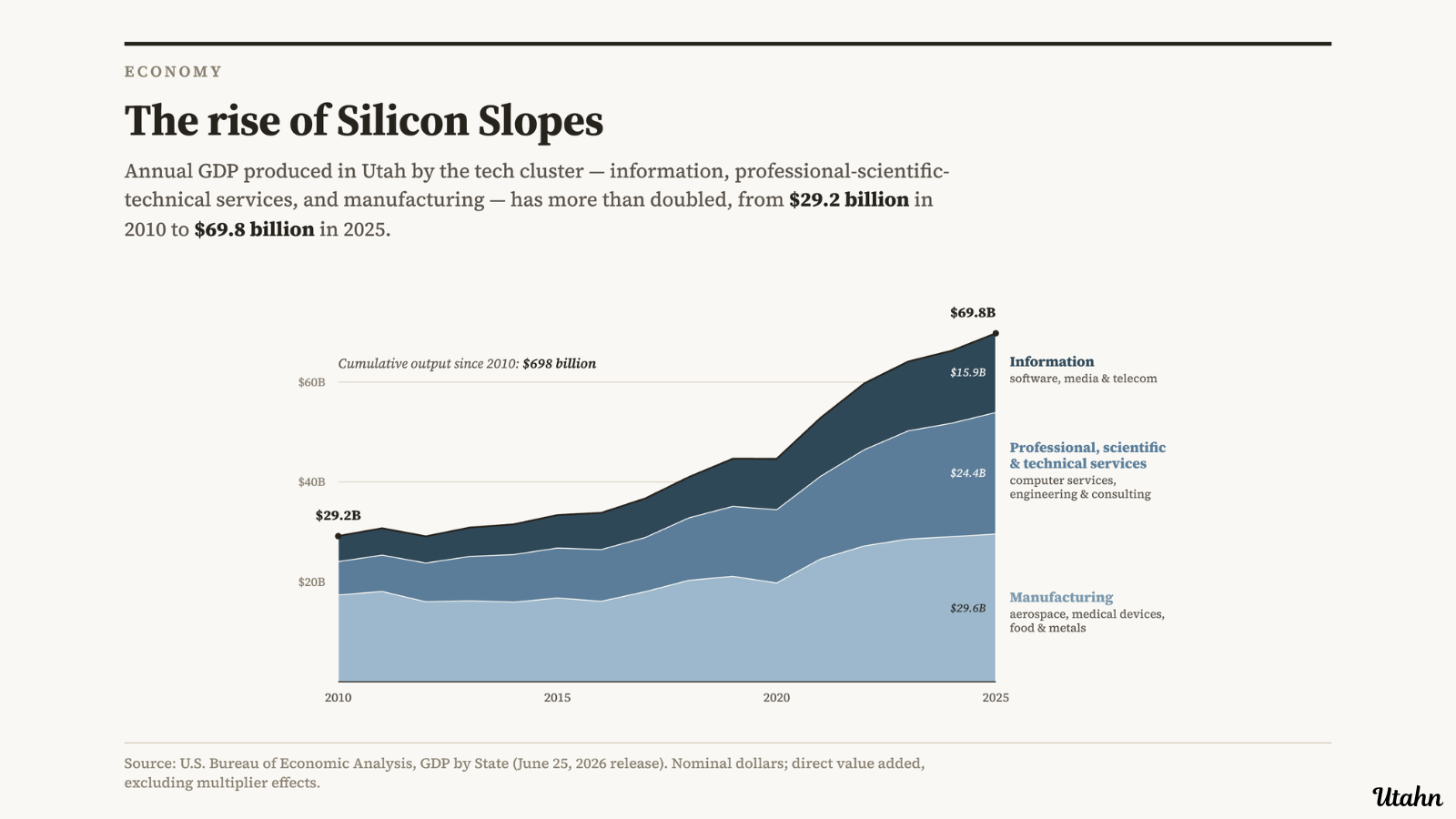
The rise of Silicon Slopes can’t be overstated. During this same time period, Utah’s entire economy produced about $3.12 trillion. That means the tech cluster accounts for 22.4% of everything the state has generated since 2010. That share has remained remarkably steady (between 21% and 25%) even as the annual dollar figure has grown from $29.2 billion to $69.8 billion.
The brand itself is globally recognized, with the majority of the organization’s website traffic coming from outside the state, proving you’re never a prophet in your own land.
Silicon Slopes is arguably one of the three most recognizable brands in the state, behind The Church of Jesus Christ of Latter-day Saints and The Utah Jazz. On top of that, despite what I wrote in the previous section, there has never been more talent or venture capital within Utah’s tech sector.
And yet.
Utah has changed dramatically since 2010. My grandpa, were he still with us, wouldn't recognize the place. He'd likely be disappointed in the small role I've played in this change. He'd be right; he was always right.
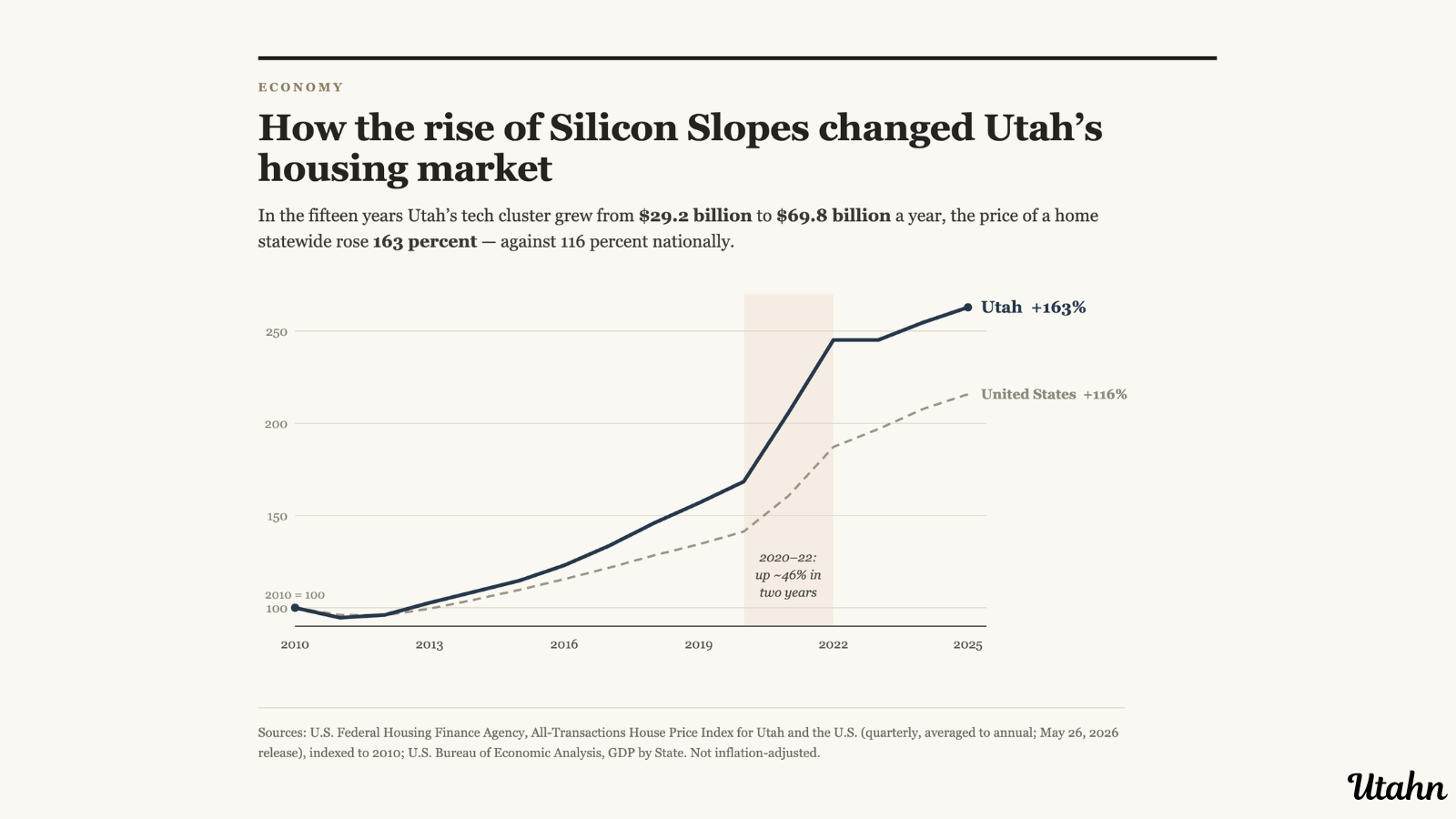
In the fifteen years Utah's tech cluster grew from $29.2 billion to $69.8 billion a year, the price of a home statewide rose 163%, far outpacing the national average.
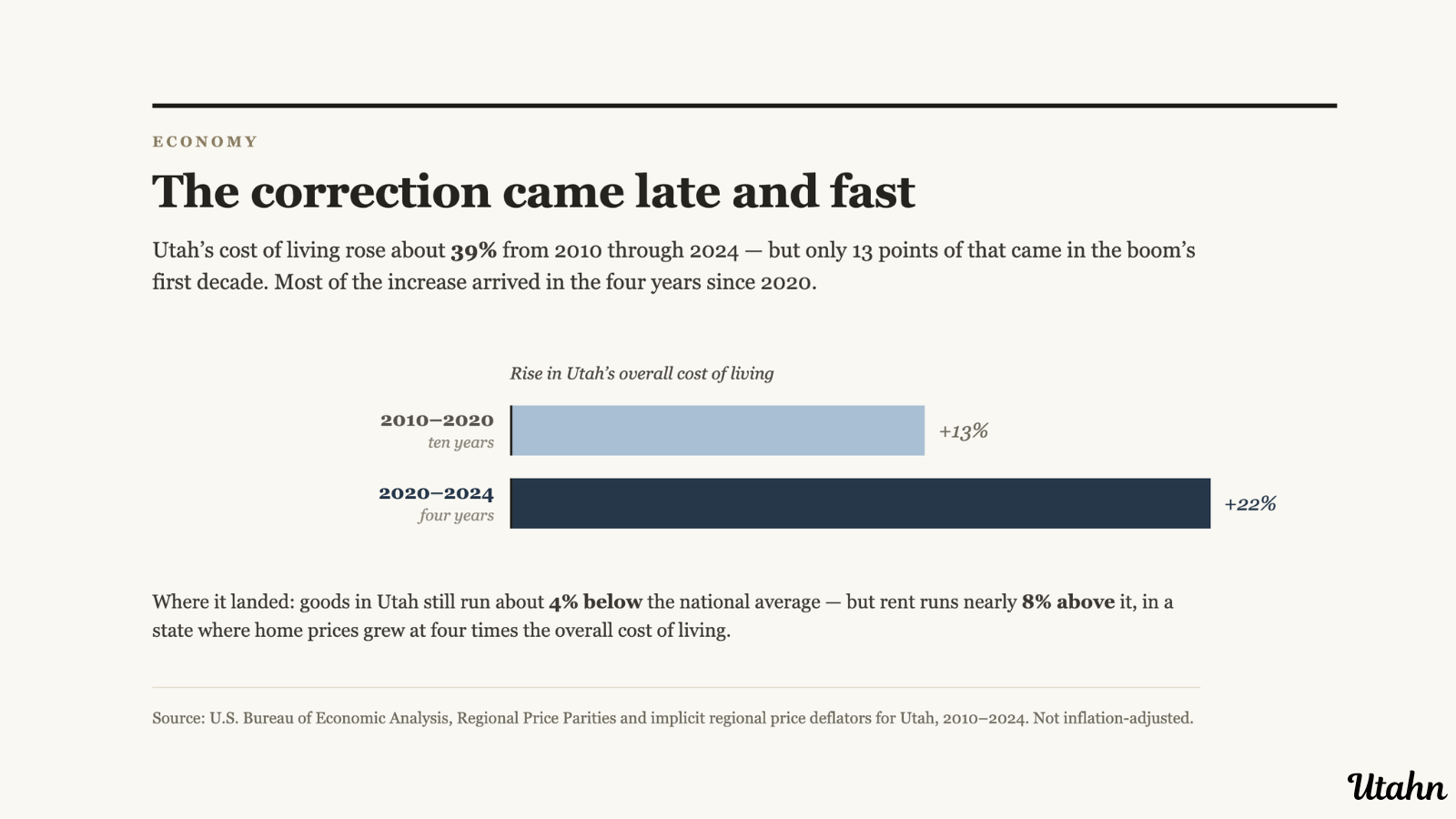
Interestingly, during the first decade of the Silicon Slopes boom, Utah's overall cost of living sat slightly below the national average and, in fact, became relatively cheaper as the state grew wealthier, which is not how this kind of thing is supposed to go.
The correction came late and fast. Since 2020, the cost of living in Utah has risen by more than 22% (that's just through 2024; the number is likely higher by now). The overall cost of living rose about 39% from 2010 through 2024, but only 13% of that increase came in the first 10 years.
Goods in Utah still run about 4% below the national average. Rent runs nearly 8% above it, in a state where home prices grew at four times the rate of the overall cost of living.
The old Utah bargain was that you traded a coastal salary for a place you could afford. What the numbers describe now is a state where the salary came in, groceries remained doable, and affordability failed at exactly the point that determines whether you can stay.
Then there's water. The years that built Silicon Slopes were hard ones for the Great Salt Lake. When the boom began, the lake was full enough that water still flowed through the breach in its causeway; by late 2015, that flow had stopped for the first time since 1984.
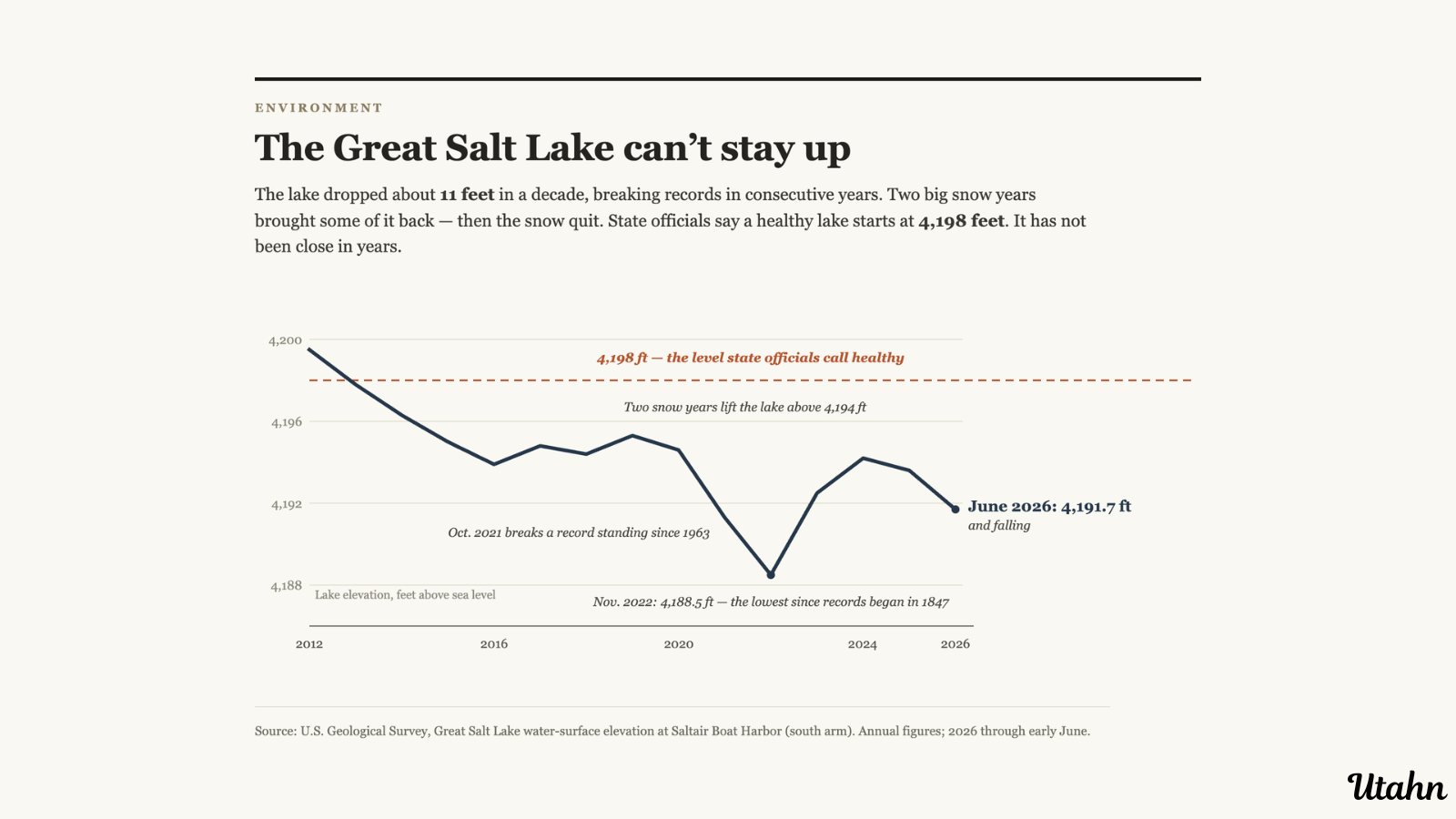
In October 2021, the lake broke a low-water record that had stood since 1963. Thirteen months later, it broke its own record, bottoming out at 4,188.5 feet in November 2022, the lowest level in a record dating back to 1847. All told, the lake dropped about 11 feet in a decade. Two big snow years brought some of that back, lifting the lake above 4,194 feet by the summer of 2024. Then the snow quit. This year the lake peaked in April at 4,192.6 feet, a foot below last year's high, and by early June it had slipped to 4,191.7 and was falling. State officials say the lake needs to reach 4,198 feet to be considered healthy. It has not been close in years.
Silicon Slopes shows up in the lake mostly as people. The Census Bureau ranked Utah the fastest-growing state in the country from 2010 to 2019, and the growth landed where the water was already spoken for. The population living inside the Great Salt Lake Basin nearly doubled between 1990 and 2020. Almost every new house came with a yard, and in Utah, 60 percent of residential water use happens outdoors.
There's a version of the math where none of this matters. A Utah family uses about 0.45 acre-feet of water a year, while an irrigated acre of farmland can take up to six, so a subdivision built on a hayfield can use less water than the crops it replaced. The state's water plan counts on those conversions. The trouble is what actually got built where. A study published last year traced forty years of land use change across the basin and found that enough new development went onto natural ground, land that had never been farmed or irrigated, to cancel out what the hayfield conversions saved. The new demand didn't replace agriculture's. Instead, it arrived on top of it.
None of this makes Silicon Slopes the villain of the lake, and none of it lets the boom off the hook. Farmers were irrigating with the lake's water a century before we built a tech ecosystem, and agriculture still accounts for roughly two-thirds of what gets consumed in the basin. What the boom did was pile new demand onto a watershed that had no margin left, and it did so in the exact years the margin disappeared.
The industry's role may not stay indirect, either. A wave of AI data center projects has been proposed across the state, from Eagle Mountain to Delta, and this year the Legislature answered with House Bill 76, which requires large data centers to report the water they divert, use, and discharge. It's a modest law. The public will see only aggregate totals, with individual facilities kept anonymous. But it makes tech the first industry Utah has asked, by name, to account for its water. And the more than $300 million lawmakers have committed to the lake since 2022 is funded by the same growth that created the need for it. The boom sits on both sides of the ledger.
Air is the one measure where the years since 2010 read as a win, at least at first. Winter smog defined the state then. Cold air sat in the valleys for days at a time, the mountains vanished, and Salt Lake kept company with Los Angeles on the worst-air lists. The fixes were unglamorous: cleaner cars and fuels, wood-burning bans, and industrial controls. They worked. The state's scientific assessment reports substantial progress: PM2.5 levels are down, there are fewer bad air days, and Cache Valley, once home to some of the nation's worst particulate readings, reached federal attainment in 2021. The gains are real but fragile. After the hard inversions of 2023, the same researchers put northern Utah a few consecutive strong winters away from failing again.
Summer went the other way. The EPA declared the Wasatch Front out of attainment for ozone in 2018, the region missed its deadlines in 2021 and 2024, and it was bumped to serious nonattainment in January 2025. Utah sued, won a stay, and this spring the EPA proposed scrapping the reclassification, reasoning that pollution drifting in from other countries pushed the region over the line. As the great Carine Clarke likes to say, maybe so. Ozone still forms when heat cooks emissions, and the summers keep getting hotter.
Meanwhile, two problems arrived that no air regulator can touch. The receding lake left a bed that produces toxic dust from behind a fragile, eroding crust, and three-quarters of the big dust storms blow straight into Layton, Syracuse and Ogden. University toxicologists now call that dust a health hazard rather than a nuisance.
Wildfires across the West now burn hot enough that their smoke plumes rise a quarter mile higher than they did twenty years ago, which is how several Utah cities spent days this June among the ten worst air-quality readings in the country while ash settled on cars in Utah County.
Utah cleaned up the pollution it made itself. The new pollution comes from a burning state and a drying lake. There's no permit to deny that fixes those problems.
What future do Utahns want?
Since its inception, Silicon Slopes has hosted thousands of events, both big and small, across the state on a wide range of topics. We never once held an event to discuss whether Utah should become a global tech hub. We never asked Utahns outside our community whether they thought it was a good idea, never seriously considered whether the ecosystem we were building had any negative impacts on the state, and never thought much about our role in shaping the state's economy or future.
It's unclear whether doing any of that would have changed anything, but as we enter the age of AI, avoiding the same mistake seems all the more urgent.
At a recent Silicon Slopes event with Governor Cox, a good friend of mine lamented that Utah doesn't have a single Fortune 500 company. That's true. It's odd that a state that ranks at the top for innovation doesn't have one. My friend argues that we should actively recruit large companies to move to Utah. It's a valid effort to consider. I can't help but wonder how everyday Utahns feel about it.
The upsides are obvious, mostly related to the state's GDP. There's also the high-quality talent that comes out of companies at that level planting their roots here. The inherent value in all of that is undeniable. But what are the downsides? Are there any? What do Utahns (the overwhelming majority) outside of the tech cluster think? Grandpa was a farmer. I don't remember a single conversation where he mentioned the state's GDP. I can't imagine he cared. The health, happiness, and overall well-being of the community he lived in mattered more to him than GDP growth.
The case for going all-in on big business or big tech is where things get complicated. For example, the top argument for building more data centers is the need to beat China in the AI race. What does that mean exactly? Will someone, anyone, ask that follow-up question the next time "We have to beat China" is spoken into a microphone?
First, it's not clear that we're beating China in the AI race. It's not clear we can. But beyond that, beat them at what? China uses AI to enact overwhelming surveillance of its own citizens. We need to beat them at that? Possible to put that up for a vote? Take a look at how Americans have reacted to Flock cameras being placed on traffic lights throughout the country.
We beat China to social media. Are we better off or worse off because of it?
What does winning mean? We were promised we’d be tired of winning. It's possible Americans are tired of the kind of winning that’s led to half a century of widening income inequality, record levels of household debt, and the feeling that their children will inherit a world worse than the one they grew up in.
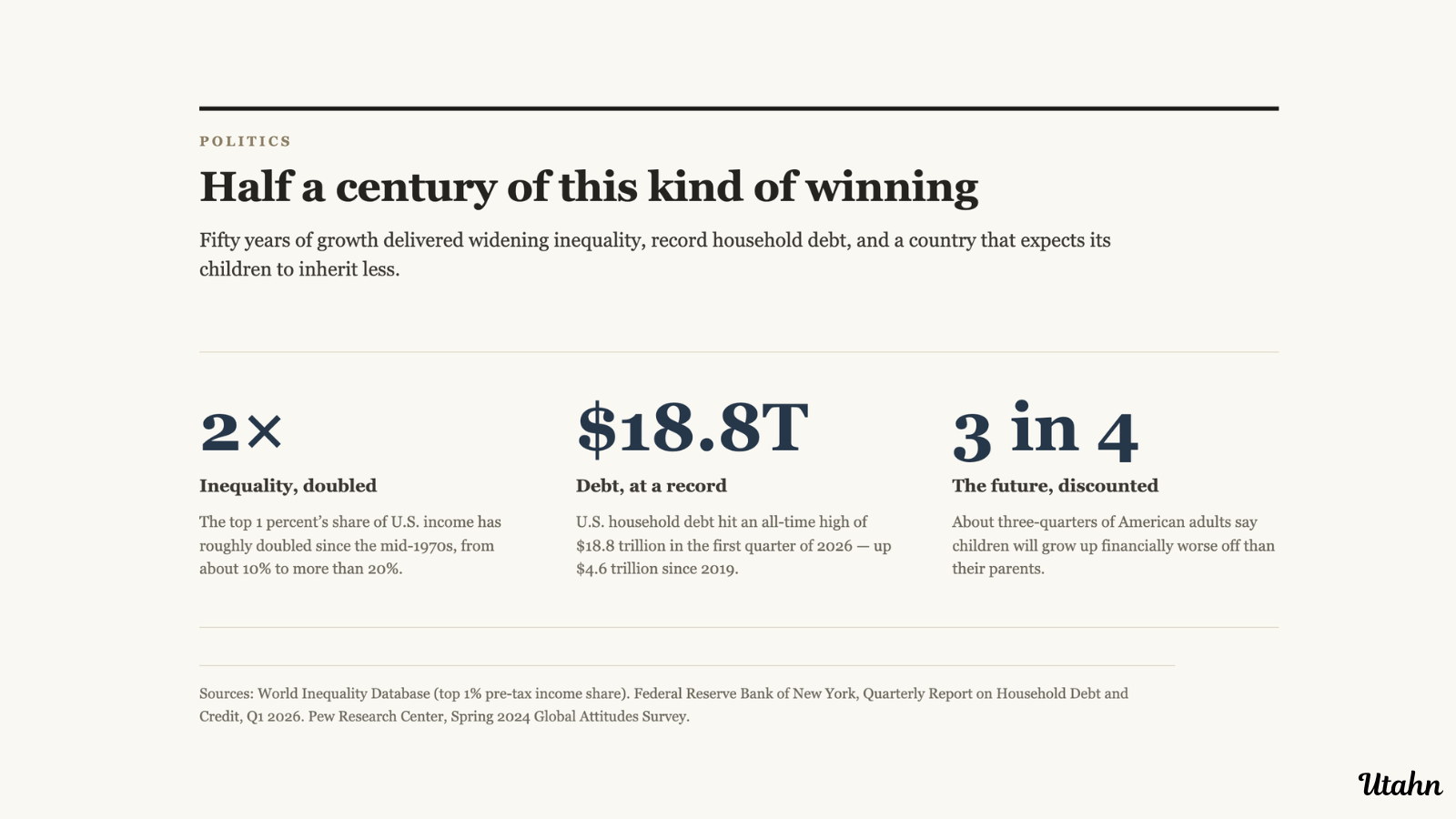
Is any of that sustainable? I imagine most Utahns think that's a fair question, and would appreciate a say in the future being proposed. And maybe they'll want to go all-in on AI (to the detriment of our home-grown tech companies), bringing Fortune 500 companies to the state, and helping the richest companies in human history build data centers to "beat" China.
This time, Silicon Slopes intends to ask. We're planning town halls this fall throughout the state to hear how Utahns feel about the future being built, and the one they'd like to see instead. What future do Utahns want?
Onward, ever onward
There's no time, let alone a need, for pessimism. The future is still being determined. Fortunately, Utah is well-positioned to face these challenges, thanks to the blood, sweat, and tears of our forefathers.
What would they do if they were alive today? How can we best honor their legacy? What kind of future do we want to build? Such questions are worth a ponder or two as we celebrate Pioneer Day in the year of our 130th anniversary as a state.
On the Silicon Slopes front, I believe Utah is the world's entrepreneurial capital. You'll find no corresponding link to back up that claim, but how could it not be true of a people who transformed a desert into Zion?
For too long, Silicon Slopes has celebrated venture-backed entrepreneurs over entrepreneurs who never have and never should raise venture capital. Small businesses are the lifeblood of this state, as they're the lifeblood of this country. We should celebrate the entrepreneurs who build companies that provide for their families, customers, and communities. At least as much, if not more, than the 1% of those who are lucky (or unlucky, depending on your perspective) enough to raise venture capital.
I believe this is why Start School is already on track to be the most successful nonprofit entrepreneurship program in Utah history. It’s not because Silicon Slopes is amazing. It's because we're removing barriers, providing access to entrepreneurship for all Utahns, and surrounding those in the program with everything they need to succeed at a time when you can do more with less than ever before.
Start School is free because opportunity that costs something is not really opportunity. The best mentors in the state show up without equity stakes, investment theses, or angles. They help because helping is the point. Silicon Slopes has always believed that the chances you give are equal to the chances you take. Start School is what that looks like in practice.
Silicon Slopes exists to ensure Utah remains the best place in the world to start, grow, and scale a company. That's the new mission.
Onward, ever onward.


